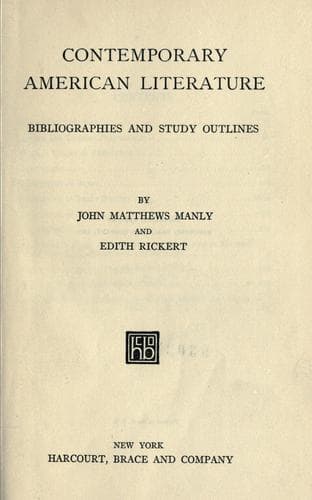
Contemporary American Literature: Bibliographies and Study OutlinesManly, John Matthews
General
Contemporary American Literature: Bibliographies and Study Outlines
Manly, John Matthews
American literature -- 20th century -- Bio-bibliography; American literature -- Outlines, syllabi, etc.
2. Consider also this from his own theory of poetry: "Poetry is a sort of
inspired mathematics, which gives us equations, not for abstract figures,
triangles, spheres and the like, but equations for the human emotions. If
one have a mind which inclines to magic rather than science, one will
prefer to speak of these equations as spells or incantations; it sounds
more arcane, mysterious, recondite."
Can this be related to the qualities of Mr. Pound's poetry?
3. After reading Mr. Pound's output, discuss the adequacy of the
following: "When content has become for an artist merely something to
inflate and display form with, then the petty serves as well as the
great, the ignoble equally with the lofty, the unlovely like the
beautiful, the sordid as the clean.... Real feeling consequently becomes
rarer, and the artist descends to trivialities of observation, vagaries
of assertion, or mere _bravado_ of standards and expression--pure tilting
at convention."
BIBLIOGRAPHY
Provenca: Poems Selected from Personae, Exultations, and Canzoniere.
1910.
The Spirit of Romance. 1910.
The Sonnets and Ballate of Cavalcanti. 1912. (Translations.)
Ripostes of Ezra Pound, whereto are Appended the Complete Poetical Works
of T.E. Hulme. 1912.
Gaudier Brzeska; a Memoir. 1916.
Lustra of Ezra Pound, with Earlier Poems. 1917.
Noh; or, Accomplishment; a Study of the Classical Stage of Japan. 1917.
(With Ernest F. Fenollosa.)
Pavannes and Divisions. 1918. (Essays and sketches.)
Quia Pauper Amavi. 1919. (English edition.)
Instigations, 1920. (Criticism.)
*Umbra: the Early Poems of Ezra Pound, All That He Now Wishes to Keep
in Circulation from "Personae," "Exultations," "Ripostes." With
Translations from Guido Cavalcanti and Arnaut Daniel and Poems by
the Late T.E. Hulme. 1920.
Also in: Des Imagistes. 1914.
Poetry. (_Passim._)
The Little Review. (_Passim._)
Cf. also Ezra Pound, his Metric and Poetry. 1917. (Bibliography, p. 29.)
STUDIES AND REVIEWS
Untermeyer.
Acad. 81 ('11): 354.
Ath. 1911, 2: 238; 1919, 2: 1065, 1132, 1268.
Bookm. 35 ('12): 156; 46 ('18): 577.
Bookm. (Lond.) 36 ('09): 154 (portrait); 52 ('17): 151.
Chapbook, 1-2: May, 1920: 22. (Fletcher.)
Dial, 54 ('13): 370; 69 ('20): 283 (portrait); 72 ('22): 87.
Egoist, 2 ('15): 71; 4 ('17): 7, 27, 44.
Eng. Rev. 2 ('09): 627.
Ind. 70 ('11): 259 (portrait).
Lond. Times, Sept. 20, 1918: 437.
New Repub. 16 ('18): 83.
New Statesman, 8 ('17): 332, 476.
No. Am. 211 ('20): 658. (May Sinclair.)
Poetry, 7 ('16): 249 (Carl Sandburg); 11 ('18): 330; 12 ('18): 221;
14 ('19): 52 (William Gardner Hale); 15 ('20): 211; 16 ('20): 213.
+(John) Herbert Quick+ (Iowa, 1861)--novelist.
Public-domain text, read in full here on John Shaqi.
Reviews
Reviews
No reviews yet
Be the first to share your thoughts on this work.
Elsewhere in the archive
Join the Discussion
Join the discussion
Sign in to leave a comment or review.
Sign InorCreate an account