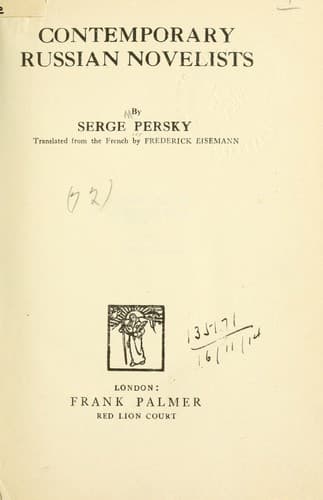
Novelists, Russian; Russian fiction -- History and criticism
But death approaches; and this man who thinks himself superior and
who scorns the deacon because he dreams of light and the sun, now
feels disturbed in his turn. In making up the balance-sheet of this
existence which, up to this time, he believed he hated, he remembers
a stream of warm light which, during the day, used to come in
through the window and gild the ceiling; and he remembers how the
sun used to shine on the banks of the Volga, near his home. With a
terrible sob, beating his hands on his breast, he falls back on his
bed, right against the deacon, whom he hears silently weeping.
"And thus they wept together. They wept for the sun which they were
never to see again, for the apple-tree with fruit which they were
not going to eat, for the shadow that was to envelop them, for dear
life and cruel death!"
* * * * *
Petka--the hero of "Petka in the Country"--is, at ten years of age,
a barber's apprentice. He does not yet smoke as does his thirteen
year old friend Nicolka, whom he wants to equal in everything.
Petka's principal occupation, in the rare moments when the shop is
empty, is to look out of the window at the poorly dressed men and
women who are sitting on the benches of the boulevard. In the
meantime, Nicolka goes through the streets of ill fame, and comes
back and tells Petka all his experiences. The precocious knowledge
of Nicolka astonishes the child, whose one ambition is to be like
his friend one of these days. While waiting, he dreams of a vague
country, but he cannot guess its location nor its character. And no
one comes to take him there. From morning till evening he always
hears the same jerky cry: "Some water, boy!"
But one morning his mother, the cook Nadezhda, tells the barber that
her master and mistress have told her to take Petka to the country
for a few days. Then begins for him an enchanted existence. He goes
in bathing four times a day, fishes, goes on long walks, climbs
trees, rolls in the grass. When, at the end of a week, the barber
claims his apprentice, the child does not understand: he has
completely forgotten the city and the dirty barber-shop; and the
return is very sad. Again is heard the jerky cry: "Some water, boy!"
followed by a menacing murmur of "Come! Come!" if the child spills
any of the water, or has not understood the orders.
"And, during the night, in the place where Petka and Nicolka sleep
side by side, a weak little voice speaks of the country, of things
that do not exist, of things that no one has ever heard of or
seen!..."
Public-domain text, read in full here on John Shaqi.
Reviews
Reviews
No reviews yet
Be the first to share your thoughts on this work.
Elsewhere in the archive
Join the Discussion
Join the discussion
Sign in to leave a comment or review.
Sign InorCreate an account