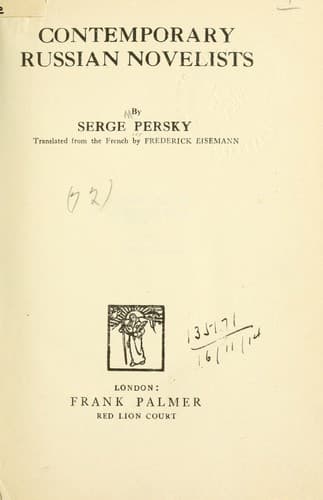
Novelists, Russian; Russian fiction -- History and criticism
What, then, constitutes the essence of Andreyev's talent is an
extreme impressionability, a daring in descriptions of the negative
sides of reality, melancholy moods and the torments of existence. As
he usually portrays general suffering and sickness rather than
definite types, his heroes are mostly incarnations and symbols. The
very titles of some of his stories indicate the abstract character
of his work. Such are: "Silence," "The Thought," and "The Lie." In
this respect he has carried on the work of Poe, whose influence on
him is incontestable. These two writers have in common a refined and
morbid sensibility, a predilection for the horrible and a passion
for the study of the same kind of subjects,--solitude, silence,
death. But the powerful fantasy of the American author, which does
not come in touch with reality, wanders freely through the whole
world and through all the centuries of history. His heroes take
refuge in half-crumbled castles, they look at the reader from the
top of craggy rocks, whither their love of solitude has led them;
even death itself is not a repulsive skeleton, but rather a majestic
form, full of grandiose mystery. Andreyev, on the other hand, but
rarely breaks the bounds which unite him to reality. His heroes are
living people, who act, and whose banal life ends with a banal
death. This realism and this passionate love of truth make the
strength and the beauty of all his work.
* * * * *
A certain harmony between the imaginative and the real element is
characteristic of the best of Andreyev's productions, especially his
last stories: "The Red Laugh," "The Governor," "The Shadows," and
"The Seven Who Were Hanged."
"The Red Laugh" is the symbol, the incarnation, of the bloody and
implacable cynicism of war. The psychologist of the mysterious has,
in these pages, recorded the terrifying aspects of the Manchurian
campaign, which one could not have foreseen in all of its horror. He
has shown in a lasting manner the poor human creature torn from his
home, debased to the role of a piece of mechanism. Not knowing where
he is being led to, he goes, making murderous gestures, the meaning
of which he does not know, without even having the illusory
consolation of possible personal bravery, being killed by the shots
of an invisible enemy, or, what is worse, being killed by the shots
of his own comrades--and all of this, automatically, stupidly. The
feeling of terror, the somewhat mystical intuition of events which,
at times, seem to be paradoxes in the other works of Andreyev, are
perfectly adapted to this terribly real representation of the
effects of war.
The inner drama which Andreyev analyzes in "The Governor" makes a
bold contrast with the violent pages of "The Red Laugh," the savage
powers of which attain the final limits of horror.
Public-domain text, read in full here on John Shaqi.
Reviews
Reviews
No reviews yet
Be the first to share your thoughts on this work.
Elsewhere in the archive
Join the Discussion
Join the discussion
Sign in to leave a comment or review.
Sign InorCreate an account