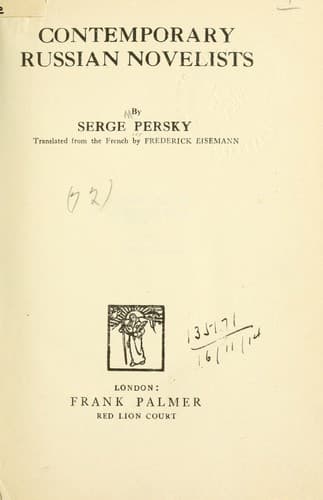
Novelists, Russian; Russian fiction -- History and criticism
Revenge for the dying emperor was long in coming. But now, after
eleven centuries, the prophecy of Julian is accomplished: heroic
antiquity, everlastingly young, arises from the grave. On all sides
the gods are resurrected. Their marble effigies, so long buried,
reappear. Both the powerful and the humble receive them with
enthusiasm and rejoice at seeing them. It is an irresistible
outburst which carries with it all classes of the Italian people.
Like a wind-blown flame, Greek genius inspires a new life in the
world. But, while a sweeter and more humane moral feeling tries to
liberalize the church, the sombre voice of Savonarola, hardened by
the terrible corruption of manners, mounts ever more menacingly:
"Oh, Italy! oh, Rome! I am going to deliver you up into the hands of
a people who will efface you from among the nations. I see them, the
enemies who descend like hungry tigers.... Florence, what have you
done? Do you want me to tell you? Your iniquity has heaped up the
measure; prepare for a terrible plague! Oh, Lord, thou art witness
that I tried to keep off this crumbling ruin from my brothers; but I
can do no more, my strength is failing me. Do not sleep, oh, Lord!
Dost Thou not see that we are becoming a shame to the world? How
many times we have called to Thee! How many tears we have shed!
Where is Thy providence? Where is Thy goodness? Where is Thy
fidelity? Stretch forth Thy helping hand to us!"
And thus the antagonism between the "God-man" and the "man-God" of
Hellenic paganism expresses itself more strongly than ever before.
The picture of the Renaissance that Merezhkovsky paints for us is
very full, very rich, at times even a little overburdened with
episodes and people. One constantly rubs shoulders with Leonardo da
Vinci, the duchess Beatrice of Este, regent of Milan, the favorite
Lucrecia Crivelli, the mysterious Gioconda, Charles VIII, Louis XII
and Francis I, kings of France, and also with Caesar Borgia; we find
here the preaching of Savonarola, the death of the pope Alexander
VI (Borgia), Marshal Trivulce, the triumphal entry of the French
into Milan, the diplomacy of Niccolo Machiavelli. In fact, as has
been said above, there are too many events and characters.
* * * * *
Two centuries go by and now we come to the third novel, "Peter and
Alexis." The scene is in Russia, and the hero is Peter the Great,
whom Merezhkovsky represents as a worshipper of things Olympian. He
gives a magnificent description of the orgies held by the emperor in
honor of Bacchus and Venus, especially the latter, whose statue he
expressly ordered from Rome and installed in the Summer Garden at
St. Petersburg.
Public-domain text, read in full here on John Shaqi.
Reviews
Reviews
No reviews yet
Be the first to share your thoughts on this work.
Elsewhere in the archive
Join the Discussion
Join the discussion
Sign in to leave a comment or review.
Sign InorCreate an account