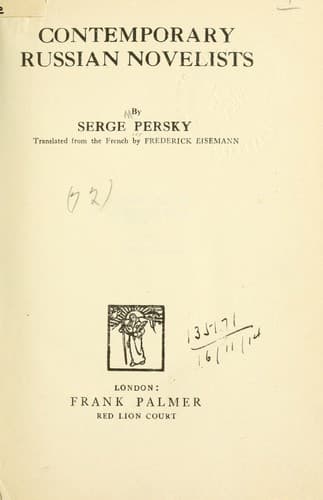
Novelists, Russian; Russian fiction -- History and criticism
Such is the tie that binds Peter the Great, Julian, and Leonardo
together. But this tie is weakened by the fact that Peter, an
essentially practical and utilitarian genius, was not the man to
become inspired with Hellenic poetry, and if the author introduces
the Tsar into the society of Julian the Apostate and of Leonardo da
Vinci, it is because Peter the Great was one of those indefatigable
strugglers, who, to attain their ends, put themselves above the
obligations of ordinary morality, one of those supermen, who
hesitate at nothing in satisfying the instincts of their egoisms, of
their dominating wills. In fact, the heroes of Merezhkovsky's novels
all belong in the category of the Nietzschean type of superman,
which explains their philosophical relationship and the sort of
trilogy which these three novels form. Thus, Julian the Apostate,
who tried in vain during his life to make history repeat itself, by
transplanting pagan traditions into a plot which had become unfit to
receive them, and who died in the effort to preserve a faith--does
not this man, then, incarnate that implacable pursuit of the
"integral personality" so extolled by Nietzsche? Leonardo da Vinci,
that great universal and keen mind, who gave himself over to all the
impulses of his creative genius, not caring whether the impulses are
worthy or harmful, appears as a luminous manifestation of that state
of the soul "beyond good and bad" which characterizes the superman.
And is not Peter the Great also a veritable superman; a man who,
through his iron will, upset all the ancient institutions of aged
Russia, and who did not even prevent the assassination of his son
Alexis, inasmuch as he thought that it was for the good of his
country?
At all events, the interest and value of "Peter and Alexis" does not
rest in its philosophic ideas and in the Nietzschean obsession, but
rather in the art with which Merezhkovsky faithfully depicts the
psychology of his heroes. The successive phases of this terrible
tragedy lead up to a striking climax, and set off, one against the
other, temperaments so entirely opposed that the reciprocal
tenderness of the father and son is transformed finally into
suspicion and hate, and the father resolves to sacrifice the life of
his son to what appears to him to be the right of the State. The
novel, although a little overburdened with details, is an excellent
analysis of the customs of the Russia of former times.
Public-domain text, read in full here on John Shaqi.
Reviews
Reviews
No reviews yet
Be the first to share your thoughts on this work.
Elsewhere in the archive
Join the Discussion
Join the discussion
Sign in to leave a comment or review.
Sign InorCreate an account