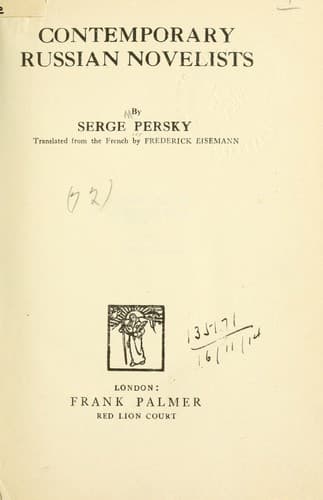
Novelists, Russian; Russian fiction -- History and criticism
As is evident, these three works of Merezhkovsky belong to the
"genre" of the historical and philosophical novel which demands,
besides the power to call up past ages, a careful education and the
gift of clear-sightedness. And the novelist completely fulfills
these requirements. He knows his subject, he studies all the
necessary documents with the greatest care and follows every story
to its source; finally, before taking up his pen, he visits the
countries and the cities in which the stories take place. Thus, in
order better to understand Leonardo da Vinci, in order to live his
life, the author of "The Resurrection of the Gods" traversed Italy
and France from one end to the other, in the same way that he had
traveled all over Greece so that he could give us a more life-like
Julian. With the same care, he spent a long time reading Russian
historical documents in order to present the reader with a better
picture of the customs of the time of Peter the Great. The result is
a series of historical pictures, almost perfect in their accuracy.
If Merezhkovsky had no other merit than this faithful portrayal of
the past, his novels even then would be read with interest and
pleasure.
Some critics have remarked that the most glaring defect in his books
lies in their construction. His novels often disregard the laws
relating to this sort of literature, which demand the clever
grouping of the characters and events around a principal hero. It is
true that this unity and the sense of proportion absolutely
necessary for any sort of harmony are not to be found in his works.
The details predominate to the detriment of important facts; the
people of secondary importance are sometimes drawn better than the
heroes themselves, whose adventures are entirely unconnected. There
is a series of jumps from one situation to another, with gaps and
interruptions of considerable length, which break the chain of
events. It is for this reason that, instead of seeing a historical
fresco, we see a whole gallery of sketches, executed with subtle
artistry, but insufficiently connected with the main action of the
drama.
These observations apply especially to the first attempt of the
young author: "The Death of the Gods"; "The Resurrection of the
Gods" and "Peter and Alexis" are more skilfully composed. They
indicate a stronger tendency towards unity; one feels that an
infinitely firmer and more experienced brush has been used; the
colors are richer and they do not suffer from that monotony of
effect and of color so noticeable in "The Death of the Gods," where
the author too often uses the same devices. As to the characters of
Leonardo da Vinci and Peter the Great, they are very carefully
worked out, and the events in the lives of the Italian master and
the Russian Tsar are narrated with magnificent psychological
analysis, which forces the reader to sympathize with the heroes even
more than he would naturally.
Public-domain text, read in full here on John Shaqi.
Reviews
Reviews
No reviews yet
Be the first to share your thoughts on this work.
Elsewhere in the archive
Join the Discussion
Join the discussion
Sign in to leave a comment or review.
Sign InorCreate an account