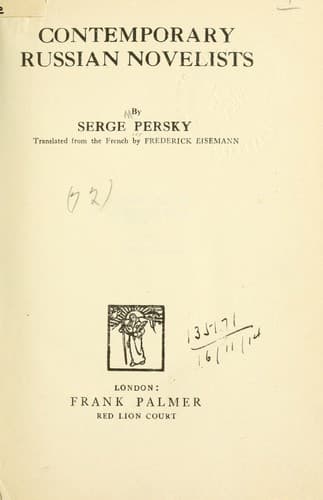
Novelists, Russian; Russian fiction -- History and criticism
"What about those three men?" asks the captain eagerly.
"Shot, captain!"
"And the old man? The old man?... what have you done with him?"
"We shot him along with the others, captain."
The next day Captain Markov asks for his discharge, having decided
to leave the army for good.
This story, which is one of the most powerful in Russian literature,
would have been enough to bring the young writer renown, even if he
had never written anything else. But his work, which is already
imposing in amount, abounds in pages of great merit, and especially
in well-constructed, brief, tragic stories.
Under this class should be mentioned "Humble People," a short story,
the scene of which is laid in the extreme north. It is the story of
a close friendship between a nurse in a dispensary and a
school-teacher.
Snowed in by a terrible winter--a winter of seven months--these two
friends find in their daily meetings the only pleasure that can make
their enforced solitude easier for them. However, in spite of their
mutual friendship, they often find their lot hard to endure. And
they continually quarrel, only to become reconciled almost
immediately. But now an unexpected event comes to break the monotony
of their existence. They are invited to a dance, given by the priest
of the neighboring village, and there they fall in love with two
charming young girls, who, they are happy to find, are not
indifferent to them. Once at home, they bestow lavish praises on
their new friends. With the touching devotion of simple and starved
hearts they speak about them as if the young girls already were
theirs.
"Mine has eyes of velvet," says the one.
"And mine has hair of pure gold," replies the other.
Gradually, however, their recollections grow weaker, and fade, just
as flowers do. Their sad life would have begun again if the spring
had not come, and with it brought deliverance. The two friends, full
of new sprightliness, get up a fishing party one day. A foolish
accident makes them both fall into the river, and they are drowned.
* * * * *
"The End of a Story," which we are about to analyze, deserves, as
does "Humble People," a special place in the work of Kuprin. It is a
little masterpiece of graceful emotion.
Kotik, a child of seven, and the son of a celebrated painter, teases
his father to tell him a story. The father racks his memory. He has
told so many that his fount is almost dry.
Suddenly an idea comes to him. Is not his own life a tender,
melancholy, and charming story? It is not a long time, twelve years
at the most, since he was a poor, obscure painter, neglected by his
masters and tormented by the miseries of his life. Discouraged, he
used continually to curse the hour in which he chose to devote
himself to art. One day, a young girl, believing in his talent, gave
him her hand and comforted him with her tenderness and angelic
goodness. And love had triumphed.
Public-domain text, read in full here on John Shaqi.
Reviews
Reviews
No reviews yet
Be the first to share your thoughts on this work.
Elsewhere in the archive
Join the Discussion
Join the discussion
Sign in to leave a comment or review.
Sign InorCreate an account