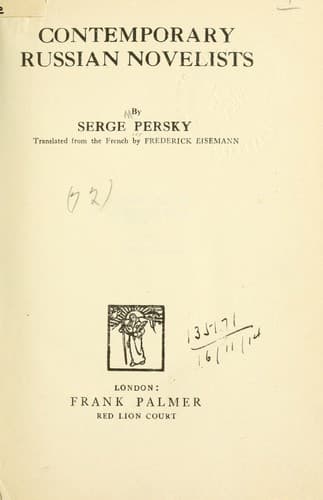
Novelists, Russian; Russian fiction -- History and criticism
These then are the principal authors--some of whom have enjoyed an
immense popularity--who treat the "cursed questions:" the rights of
the flesh, the problem of death, and other equally "cursed"
problems.
The other writers are principally occupied with social questions,
and, without rigorously following in the steps of their
predecessors, remain, however, most of the time, realists.
Among these, Sergyev-Tzensky occupies a prominent place. The stories
of this writer show us beings who seem strangers to what is going on
around them. This peculiarity comes from the fact that Tzensky does
not understand the physical facts in the same way that the
naturalists do. For him, they are the manifestations of the will of
a supernatural entity, incomprehensible, inconceivable, and, at the
same time, clearly hostile to man.
His story, "The Sadness of the Fields," testifies to this singular
conception. A farmer and his wife, good and peaceful people, have
for many years wished for a child. Up to this time, the six children
which the mother has given birth to have died in their infancy. They
are anxiously awaiting the seventh. Will this one live? Will not the
sadness of the fields, which puts its imprint on everything, kill it
as it has killed the others? Alas! the child is not viable, and the
mother dies in child-birth. They are buried, and "the fields and the
surrounding country forever keep their powerful and mysterious
melancholy."
"The Fluctuation" is one of the most curious and beautiful of all of
Tzensky's stories. Anton Antonovich, a rich and enterprising
merchant, of a very violent and unruly character, lives like a wolf
in his domains, alone with his family, without seeing any of his
neighbors. The peasants detest him. As his partners and helpers, he
always engages nonentities, without power of initiative, who blindly
follow his orders. Intellectual and energetic men cannot get along
with him. Men, beasts, and nature in its entirety, are considered by
this man as having been especially created for his service. The one
end of his life is wealth and power. The only beings he loves are
his wife and his three sons; but even they have to bow down to his
will.
One day, he buys some straw and insures it against fire. Sometime
later, it burns. They accuse him of having been the incendiary.
Ridiculous accusation! He is a millionaire and the straw barely cost
a few hundred rubles. The old man makes fun of the whole affair; he
insults the judge, his own lawyer, and even the jury. He feels the
impending misfortune, but his inborn violence carries him away from
prudence. He is condemned to hard labor and he succumbs to a
sickness that he has been feeling coming on for a long time. He had
made a pillager's nest for himself, and he died like a pillager,
abandoned even by those who were dear to him.
Public-domain text, read in full here on John Shaqi.
Reviews
Reviews
No reviews yet
Be the first to share your thoughts on this work.
Elsewhere in the archive
Join the Discussion
Join the discussion
Sign in to leave a comment or review.
Sign InorCreate an account