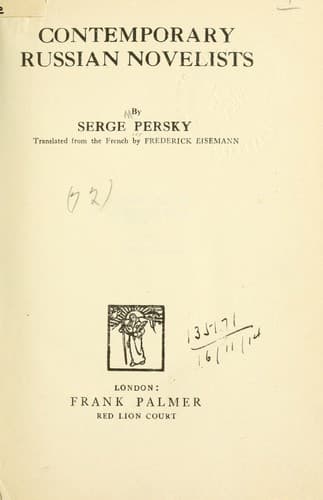
Novelists, Russian; Russian fiction -- History and criticism
Once the resolution was made to pursue his studies in a more
practical manner, he becomes the house-surgeon of a hospital. But
even there a mass of problems disturb him. He sees how dangerous the
simplest operations are; he is frightened by the unrestraint of the
doctors, who try new methods on the sick, methods the effects of
which are not known, methods that result in the patient's being
inoculated with more sickness. Medicine cannot progress without
direct experimentation, and experience is gained at the expense of
the more unfortunate. Nevertheless, Veressayev does not argue
against this way of working; he shows the facts, and leaves it to
the reader to decide. On the other hand, he does not hide his fear
of the common ignorance of all doctors. Every individual differs
from his neighbor. How distinguish their idiosyncrasies? Once the
scope of a sickness is known, what remedy shall be used? Some say
this, others, that. How shall one choose? Veressayev has felt all of
this; he has tried to harden himself against the unreasonable
ingratitude of some, the scepticism of others; he realizes that
patience, resignation, and heroism are needed in order to struggle
against and support the mortifications in the career of a doctor.
How much easier it would be not to consider medicine as infallible;
to study it as an art rather than as a science. But people prefer to
believe that doctors know everything. They do not want to see the
reality, and this is the reason why sad, and at times tragic
conflicts arise between patient and physician.
Finally, what could the most perfect medical science and the
cleverest doctor do against the enormous mass of sickness and
suffering that are the inevitable result of the social evils, of
which poverty is the most conspicuous? How can one tell a man that
his trade is running him down and that he does not get enough
nourishment? How can one order a man to eat better food, to get more
sleep and more pure air? First, and most important, is the necessity
of curing the social organism.
It is easy to see why this book made many enemies for its author.
There is too much frankness and conscientiousness in these studies
not to anger those who have their greatest interest in concealing
the truth! The upright man who sees primarily in medicine a means to
relieve human suffering, cannot realize without sadness the many
abuses hidden under the name of this science.
* * * * *
Public-domain text, read in full here on John Shaqi.
Reviews
Reviews
No reviews yet
Be the first to share your thoughts on this work.
Elsewhere in the archive
Join the Discussion
Join the discussion
Sign in to leave a comment or review.
Sign InorCreate an account