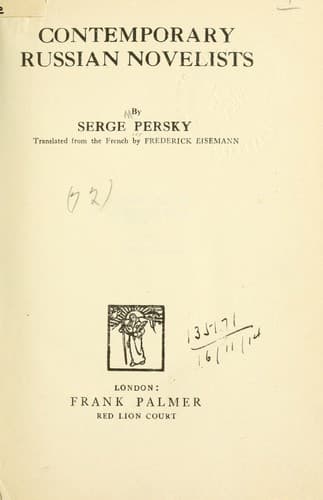
Novelists, Russian; Russian fiction -- History and criticism
Often, these expeditions were not without their risks. One day, two
of the baker's workmen happened to drown in a bog; another time,
they were taken in a police raid and passed the night in the station
house.
It was also at this time that Gorky frequented the company of
several students, not care-free and happy ones, but miserable young
fellows like those whom Turgenev described as "nourished by physical
privations and moral sufferings."
On leaving the bakery, where his health, very much weakened by the
lack of air and by bad food, did not permit him to remain any
longer, he joined those vagabonds, those wanderers, whose
melancholy companion he had been, and whose painter and poet he was
to be. In their company, he traveled through Russia in every sense
of the word, now as a longshoreman, now as a wood-chopper. Whenever
he had a copeck in his pocket he bought books and newspapers and
spent the night reading them. He suffered hunger and cold; he slept
in the open air in summer, and, in winter, in some refuge or cellar.
The feverish activity of so keen an intellect in an organism so
crushed had, as its consequence, one of the attempts at suicide
which are so frequent among the younger generation of the Russians.
In 1889, at the age of twenty-one, Gorky shot himself in the chest,
but he did not succeed in killing himself. Soon afterwards, he
became gate-keeper for the winter at Tzaratzine; but the summer had
hardly come before he began his vagabondage again, in the course of
which he undertook a thousand little jobs in order to keep himself
alive. On the road, he noticed those pariahs whom society does not
want or who do not want society. And of these, in his short stories,
he has created immortal types.
Life was still very hard for him at this time. He has given us a
moving sketch of it in his story entitled: "Once in Autumn." The
hero, who is none other than the author himself, passes the night
under an old, upturned boat, in the company of a prostitute who is
just as poor and just as abandoned as himself. They have broken into
a booth in order to steal enough bread to keep them from starving.
Gorky is sad; he wants to weep; but the poor girl, miserable as she
is, consoles him and covers him with kisses.
Public-domain text, read in full here on John Shaqi.
Reviews
Reviews
No reviews yet
Be the first to share your thoughts on this work.
Elsewhere in the archive
Join the Discussion
Join the discussion
Sign in to leave a comment or review.
Sign InorCreate an account