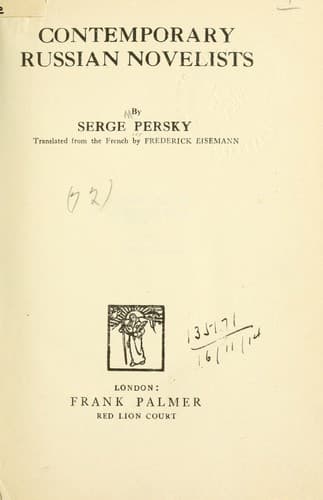
Novelists, Russian; Russian fiction -- History and criticism
Who are these "restless" people? Toward what end are they striving?
What do they represent? First, they have an immense reserve force
which they do not know what to do with; they have got out of the
rut, the rut which they despise, but it is hard for them to create
another sort of existence for themselves. Bourgeois happiness
repulses them, while all sorts of duties are hateful to them. They
consider the people who are contented with this sort of a life as
slaves, unworthy of the name of man, and they show the same disdain
for the peasants, for the leading classes, and for the workingmen.
The simple farmer excites the scorn of the "barefoot brigade:"
"As for me," says one of them, "I don't like any peasants.... They
are all dogs! They have provincial States, and they do for them....
They tremble, they are hypocrites, but they want to live; they have
one protection: the soil.... However, we must tolerate the peasant,
for he has a certain usefulness."
"What is a peasant?" asks another. And he answers the question
himself: "The peasant is for all men a matter of food, that is to
say, an animal that can be eaten. The sun, the water, the air, and
the peasant are indispensable to man's existence...."
One might think that this hostility was the fruit of a feeling of
envy provoked by the fact that the peasant seems to enjoy so many
advantages. But, on the contrary, the "barefoot brigade" admits
that the peasant subjugates his individuality for any sort of
profit, and that he cannot feel the yoke which he has voluntarily
taken in the hope of getting his daily bread.
These workingmen "who pitifully dig in the soil" are unfortunate
slaves. "They do nothing but construct, they work perpetually, their
blood and sweat are the cement of all the edifices of the earth. And
yet the remuneration which they receive, although they are crushed
by their work, does not give them shelter or enough food really to
live on."
The enlightened classes are always characterized in Gorky's works by
violent traits. The architect Shebouyev accords a sufficiently
great, but scarcely honorable, place to the category of intelligent
men to whom he belongs.
"All of us," he says, "are nonentities, deprived of happiness. We
are in such great numbers! And our numbers have been a power for so
long a time! We are animated by so many desires, pure and honest....
Why is there so much talk among us and so little action? And, all
the while, the germs are there!... All these papers, novels,
articles are germs ... just germs, and nothing else.... Some of us
write, others read; after reading, we discuss; after discussing, we
forget what we have read. For us, life is tedious, heavy, grey, and
burdensome. We live our lives, but sigh from fatigue and complain
of the heavy burdens we are carrying."
The journalist Yezhov, in "Thomas Gordeyev," expresses himself in
the same manner, but even more decisively:
Public-domain text, read in full here on John Shaqi.
Reviews
Reviews
No reviews yet
Be the first to share your thoughts on this work.
Elsewhere in the archive
Join the Discussion
Join the discussion
Sign in to leave a comment or review.
Sign InorCreate an account