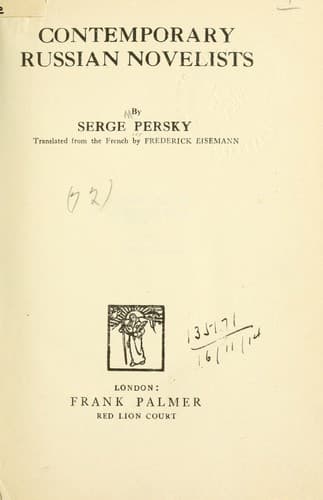
Novelists, Russian; Russian fiction -- History and criticism
What then is the teaching that we get out of Gorky's works? For,
faithful to Russian tradition, he does not practise art for art's
sake. His "barefoot brigade" and his "restless" men are generally
considered as representative of his own ideals. The principle of "Do
what seems to you to be good"--a principle which is expressed by a
wandering and free life--ought to be justified, one thinks. Critics
have risen up against this ideal, trying to prove how incompatible
the kind of existence that he conceives is with a solid political
organization, and how far from reality the men are whom he
represents.
Doubtless, in real life, people are not as original and not as
heroic as Gorky represents them to be. And he himself agrees that
their inventive faculties are very highly developed. He shows this
in putting the following words into the mouth of Promtov:
"I have very probably exaggerated, but that's not of much
importance. For, if I have exaggerated what happened, my method of
exposition has shown the true state of my soul. Perhaps, I have
served you with an imaginary roast, but the sauce is made of the
purest truth."
The end that he is after, Gorky has shown us in his story, "The
Lecturer," which contains his theories on literature. In the person
of the lecturer, he addresses himself to the men who represent the
majority of the Russian cultivated classes. He begins by analyzing
himself carefully and discovers in himself many good feelings and
honest desires, but he feels that he lacks clear and harmonious
thought, a thing which keeps all the manifestations of life in
equilibrium. Numerous doubts torment him, and his mind has been so
moved with them, his heart so wounded, that, for a long time, he has
lived "empty inside."
"What have I to say to others?" he asks himself. "That which was
told them long ago, that which has always been told them, none of
which makes any one any better. But have I the right to teach these
ideas and convictions, if I, who was brought up according to them,
act so often in opposition to them?"
With his usual sincerity, it is not to be wondered at that he
answered this question in the negative, and, to cite the words of
one of his characters, that he "refused to live in the chains which
had already been forged for free thought, and to class himself under
the label of an ism."
He has not thought it profitable to hide his doubts and has not
feared to declare openly that none of the existing philosophies suit
him, and that he is trying to follow his own path. All of his work
is but the absolute image of his own uncertainties, of his
passionate researches, and of his constant "restlessness."
Public-domain text, read in full here on John Shaqi.
Reviews
Reviews
No reviews yet
Be the first to share your thoughts on this work.
Elsewhere in the archive
Join the Discussion
Join the discussion
Sign in to leave a comment or review.
Sign InorCreate an account