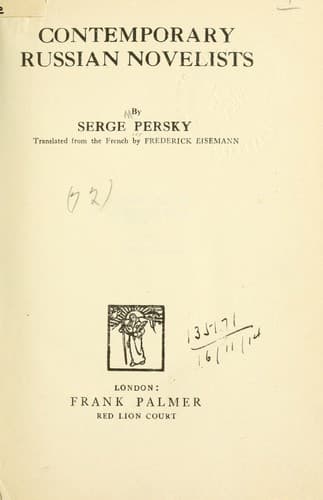
Novelists, Russian; Russian fiction -- History and criticism
As he does not work, Thomas indulges in many extravagances in
company with a journalist of very advanced ideas. Finally, one day
when he is at a fete at which are present all the wealthy members of
the merchant class, the young man, disgusted with their vices, rises
to apostrophize them in the most bitter terms. They throw themselves
on him, and he is arrested as a madman and put into an asylum. He
comes out, only to abandon himself to drink.
In "The Three," Gorky tells us the life story of Ilya Lounyev, a
poor creature, born in poverty, whose life is full of deceptions,
misfortunes, even crimes. Several times, Ilya has tried to lead a
decent life; but it is his sincerity that makes him lose his
position with the merchant for whom he works. He has believed in
beauty and in the purity of love, and he is deceived by the woman he
loves. Gradually all the baseness of the world becomes clear to him.
In a moment of jealousy he kills his mistress's lover, an old miser.
Several months later he publicly confesses his crime, and, in order
to escape from human justice, he commits suicide.
* * * * *
In his first two dramas, "The Smug Citizen," and "A Night's Refuge,"
as in his short stories, Gorky shows us his usual characters.
The Bessemenovs, comfortable, petty bourgeois, have given their
children an education. Their daughter, Tatyana, becomes a
school-teacher, but her profession does not please her. Peter, their
son, has been expelled from the university, in spite of his
indifference toward "new" ideas. The children are continually
harassed by their father, who bemoans the fact that he has given
them an education. Besides, another sadness troubles him: Nil, his
adopted son, whom he has had taught the trade of a mechanician,--an
alert and industrious fellow,--wants to marry Polya, a girl without
a fortune. The father is beside himself, for, if Nil marries, he
will never be in a condition to pay back the money that has been
spent on him. But Nil protests: he is young, and, some day, he will
repay his debt. He has not noticed that Tatyana is in love with him;
and the young girl has not strength enough to live through the
sorrow of seeing herself abandoned forever. She tries to commit
suicide, but does not succeed. While Tatyana is bemoaning her fate,
Peter has fallen in love with a young woman quite different from any
of the members of his family. Helen understands how sad Peter's
position is among these ignorant people, and she decides to marry
him, for pity as much as for love. The father is no more satisfied
with this match than he was with Nil's, and with death in his soul
he is present at the dismemberment of his family. While Helen takes
Peter, Nil goes off with Polya. The mother, a humble and kind woman,
does not understand the cause of all this dissension and, while
consoling the weeping Tatyana, she asks her husband: "Why are our
children punishing us so? Why do they make us suffer?" This play is
Public-domain text, read in full here on John Shaqi.
Reviews
Reviews
No reviews yet
Be the first to share your thoughts on this work.
Elsewhere in the archive
Join the Discussion
Join the discussion
Sign in to leave a comment or review.
Sign InorCreate an account