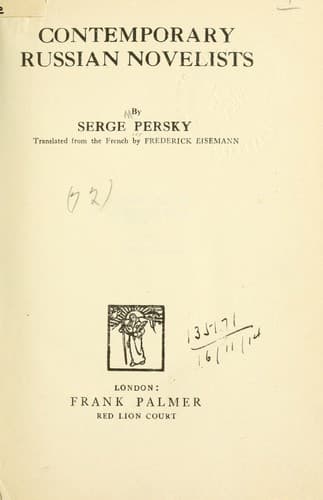
Novelists, Russian; Russian fiction -- History and criticism
The school-mistress, Vera, has conceived the daring project of
teaching the soldiers who are quartered in the village. She gets
some of them together at the edge of the neighboring woods and
there she tries to show them the ignominy of the roles they play in
times of uprisings. Angered by this unexpected talk, the soldiers
threaten the young girl. But her coolness and sincerity finally make
them listen to her with a respect mingled with admiration.
A third story, called "Slaves," in a masterful way retraces the
catastrophes of the now historical journey of January 9, 1905, at
the end of which, a crowd of 200,000 men, led by the famous pope
Gapon, went to the Tsar's palace to present their demands to him,
and were received with cannon shots.
These stories were followed by three works of great merit: "Mother,"
"A Confession," and "The Spy."
The novel "Mother" takes us into the midst of revolutionary life.
The heroes of this book belong, for the most part, to that
workingman and agricultural proletariat whose role has lately been
of such great importance in the Russian political tempests. With
marvelous psychological analysis, Gorky shows how some of these
simple creatures understand the new truth, and how it gradually
penetrates their ardent souls.
Pavel Vlassov, a young, intelligent workingman, is thirsty for
knowledge, and is the apostle of the new ideal. He throws himself
heart and soul into the dangerous struggle he has undertaken against
ignorance and oppression. The Little Russian, Andrey, is all
feeling and thought, and the peasant Rybine is inflamed by action.
Sashenka is a young girl who sacrifices herself entirely to the
Idea, and the coal-man Ignatius is driven by an obscure force to
help in a cause which he does not understand. Finest of them all is
Pelaguaya Vlassov, the principal character of the book, and Pavel's
mother.
Old and grey, Pelaguaya has passed her whole life in misery. She has
never known anything but how to suffer in silence and endure without
complaint; she has never dreamed that life could be different. One
day her father had said to her:
"It's useless to make faces! There is a fool who wants to marry
you,--take him. All girls marry, all women have children; children
are, for all parents, a sorrow. And are you, yes or no, a human
being?"
She then marries the workingman Michael Vlassov, who gets drunk
every day, beats her cruelly and kicks her, and even on his
death-bed, says: "Go to the devil.... Bitch! I'll die better alone."
Public-domain text, read in full here on John Shaqi.
Reviews
Reviews
No reviews yet
Be the first to share your thoughts on this work.
Elsewhere in the archive
Join the Discussion
Join the discussion
Sign in to leave a comment or review.
Sign InorCreate an account