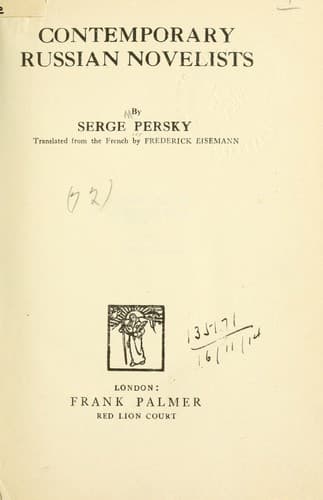
Novelists, Russian; Russian fiction -- History and criticism
"A Confession" is the story of a restless soul who untiringly
searches for the God of truth and goodness. Found as a child in a
village of central Russia, Matvey was first taken by a sacristan,
and, after his death, by Titov, the inspector of the domain. In
order to debase Matvey, whose superiority irritates him, Titov asks
him to participate in his extortions. Having become the son-in-law
of his adopted father, Matvey, on account of his love for his wife,
accepts the shameful life. But the God in whom Matvey has placed his
distracted confidence, seems to want to chastise him cruelly. After
having lost, one after the other, his wife and child, he goes away
at a venture. He enters a monastery where, among the dissolute
monks, whose vices are most repugnant, his soul gradually shakes off
the Christian dogma. On one of his pilgrimages, he gets to
Damascus. Among the workingmen, where chance has taken him, he feels
his heart opening to the truth, which he follows up with the
determination of a real Gorkyan hero. The life of the people appears
to him in its sublime simplicity. And it is in the midst of a
dazzling apotheosis--which reminds one of the most grandiose pages
of Zola's "Lourdes"--that he finally confesses the God of his ideal:
it is the people.
"People! you are my God, creator of all the gods that you have
formed from the beauty of your soul, in your troubled and laborious
search!
"Let there be no other gods on the earth but yourself, for you are
the only God, the creator of miracles!"
* * * * *
"The Spy" is a study of the Russian police. The novel treats of the
terrible Okhrana, whose mysterious affairs have become the
laughing-stock of all the foreign papers.
The principal character, about whom circle the police spies and
secret agents, is a poor orphan, weak and timid, called Evsey
Klimkov, whom his uncle, the forger Piotr, has taken into his house
and brought up with his son, the strong and brutal James. Beaten by
his schoolmates and by his cousin, the child lives in a perpetual
trance. Life seems formidable to him, like a jungle in which men are
the pitiless beasts. Everywhere, brute force or hypocrisy triumph;
everywhere, the weak are oppressed, downtrodden, conquered. And in
his feverish imagination, daily excited by facts which his terror
distorts, Evsey delights in conceiving another existence, all made
of love and goodness, an existence that he unceasingly opposes
against the hard realities of daily life, with the stubborn fervor
of a mystic.
Public-domain text, read in full here on John Shaqi.
Reviews
Reviews
No reviews yet
Be the first to share your thoughts on this work.
Elsewhere in the archive
Join the Discussion
Join the discussion
Sign in to leave a comment or review.
Sign InorCreate an account