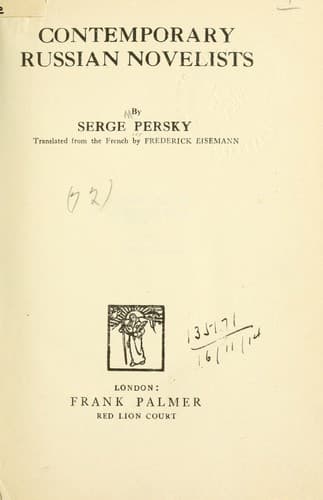
Novelists, Russian; Russian fiction -- History and criticism
With his accustomed power, Gorky shows us, in the first of these
stories, the spread of socialism among the agricultural proletariat.
He depicts village life with its pettiness and ignominy. The village
is for the most part a backward place, hostile to everything that
makes a breach in tradition. The hatching of socialism goes on
slowly. From day to day, new obstacles, helped on by the ignorance
of the peasants, hinder those who are trying to carry out their
belief. Even the village guard, Semyon, pursues them with his
hatred.
But Igor Petrovich, the propagator of these new ideas, finds, in a
few old friends and in a village woman who becomes his mistress,
some precious helpers. Thanks to them, he gradually gets up a little
circle of firm believers who gather in a cave in the woods. Every
evening, they read, discuss, and dream of a better organization,
out there in the cave. All would have gone well, if some of them had
not betrayed the leader to the police. While being led to the city
prison, the leader spoke to the soldiers who were escorting him:
"The soldiers trembled as they clicked their bayonets; they silently
listened to the legend of the generous earth which loves those who
work it. Again, their red faces were covered with drops of melted
snow; the drops ran down their cheeks like bitter tears of
humiliation; they breathed heavily, they snuffled, and I felt that
they kept walking a little faster, as if they wanted this very day
to arrive in that fairy land.
"We are no longer prisoners and soldiers; we are simply seven
Russians. I do not forget the prison, but when I remember all that I
lived through that summer and before that, my heart fills with joy,
and I feel like crying out:
"Rejoice, beloved Russian people! Your resurrection is close at
hand!"
* * * * *
"Matvey Kozhemyakine" very brilliantly returns to Gorky's early
manner. In this book no symbolic character interprets the bold
thoughts of the author. It is simply a novel of Russian provincial
life. Its simplicity does not exclude vigor, and it reminds us at
times of Balzac.
Young Matvey is the son of an old workingman who has become rich,
thanks to his energy and dishonesty. He has grown up in a large
house, adjoining a rope-yard, with his father and several servants.
His mother, whom he never knew, left home shortly after his birth,
and entered a convent in order to escape the torments of life.
Later, Matvey's father marries a young girl, in order to provide a
mother for his son, whom he loves dearly. But his new mother is not
long in finding out the dreary life which she has to lead with the
old man. In order to escape from the tedium of it, she listens to
the interesting experiences of the wandering life of the porter
Sazanov, and gives her unfaithful love in exchange.
Public-domain text, read in full here on John Shaqi.
Reviews
Reviews
No reviews yet
Be the first to share your thoughts on this work.
Elsewhere in the archive
Join the Discussion
Join the discussion
Sign in to leave a comment or review.
Sign InorCreate an account