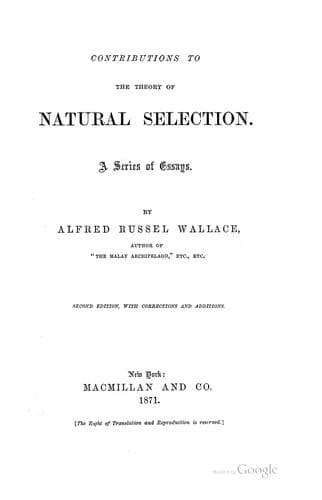
Contributions to the Theory of Natural Selection: A Series of EssaysWallace, Alfred Russel
Science
Contributions to the Theory of Natural Selection: A Series of Essays
Wallace, Alfred Russel
Natural selection
Let us now consider the fact, of Indians finding their way through
forests they have never traversed before. This is much misunderstood,
for I believe it is only performed under such special conditions, as at
once to show that instinct has nothing to do with it. A savage, it is
true, can find his way through his native forests in a direction in
which he has never traversed them before; but this is because from
infancy he has been used to wander in them, and to find his way by
indications which he has observed himself or learnt from others. Savages
make long journeys in many directions, and, their whole faculties being
directed to the subject, they gain a wide and accurate knowledge of the
topography, not only of their own district, but of all the regions round
about. Every one who has travelled in a new direction communicates his
knowledge to those who have travelled less, and descriptions of routes
and localities, and minute incidents of travel, form one of the main
staples of conversation round the evening fire. Every wanderer or
captive from another tribe adds to the store of information, and as the
very existence of individuals and of whole families and tribes, depends
upon the completeness of this knowledge, all the acute perceptive
faculties of the adult savage are devoted to acquiring and perfecting
it. The good hunter or warrior thus comes to know the bearing of every
hill and mountain range, the directions and junctions of all the
streams, the situation of each tract characterized by peculiar
vegetation, not only within the area he has himself traversed, but for
perhaps a hundred miles around it. His acute observation enables him to
detect the slightest undulations of the surface, the various changes of
subsoil and alterations in the character of the vegetation, that would
be quite imperceptible to a stranger. His eye is always open to the
direction in which he is going; the mossy side of trees, the presence of
certain plants under the shade of rocks, the morning and evening flight
of birds, are to him indications of direction, almost as sure as the sun
in the heavens. Now, if such a savage is required to find his way across
this country in a direction in which he has never been before, he is
quite equal to the task. By however circuitous a route he has come to
the point he is to start from, he has observed all the bearings and
distances so well, that he knows pretty nearly where he is, the
direction of his own home and that of the place he is required to go to.
He starts towards it, and knows that by a certain time he must cross an
upland or a river, that the streams should flow in a certain direction,
and that he should cross some of them at a certain distance from their
sources. The nature of the soil throughout the whole region is known to
him, as well as all the great features of the vegetation. As he
approaches any tract of country he has been in or near before, many
Public-domain text, read in full here on John Shaqi.
Reviews
Reviews
No reviews yet
Be the first to share your thoughts on this work.
Elsewhere in the archive
Join the Discussion
Join the discussion
Sign in to leave a comment or review.
Sign InorCreate an account