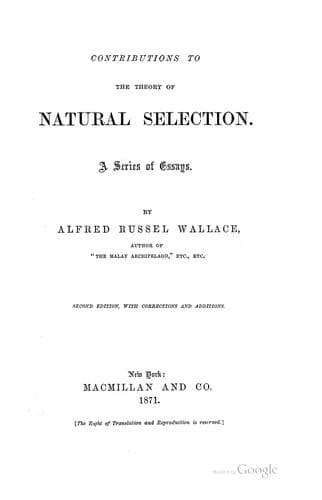
Contributions to the Theory of Natural Selection: A Series of EssaysWallace, Alfred Russel
Science
Contributions to the Theory of Natural Selection: A Series of Essays
Wallace, Alfred Russel
Natural selection
During all these changes, however, certain specialities of nest-building
would continue, for a shorter or a longer time after the causes which
had necessitated them had passed away. Such records of a vanished past
meet us everywhere, even in man's works, notwithstanding his boasted
reason. Not only are the main features of Greek architecture, mere
reproductions in stone of what were originally parts of a wooden
building, but our modern copyists of Gothic architecture often build
solid buttresses capped with weighty pinnacles, to support a wooden roof
which has no outward thrust to render them necessary; and even think
they ornament their buildings by adding sham spouts of carved stone,
while modern waterpipes, stuck on without any attempt at harmony, do the
real duty. So, when railways superseded coaches, it was thought
necessary to build the first-class carriages to imitate a number of
coach-bodies joined together; and the arm-loops for each passenger to
hold on by, which were useful when bad roads made every journey a
succession of jolts and lurches, were continued on our smooth
macadamised mail-routes, and, still more absurdly, remain to this day in
our railway carriages, the relic of a kind of locomotion we can now
hardly realize. Another good example is to be seen in our boots. When
elastic sides came into fashion we had been so long used to fasten them
with buttons or laces, that a boot without either looked bare and
unfinished, and accordingly the makers often put on a row of useless
buttons or imitation laces, because habit rendered the appearance of
them necessary to us. It is universally admitted that the habits of
children and of savages give us the best clue to the habits and mode of
thought of animals; and every one must have observed how children at
first imitate the actions of their elders, without any regard to the use
or applicability of the particular acts. So, in savages, many customs
peculiar to each tribe are handed down from father to son merely by the
force of habit, and are continued long after the purpose which they
originally served has ceased to exist. With these and a hundred similar
facts everywhere around us, we may fairly impute much of what we cannot
understand in the details of Bird-Architecture to an analogous cause. If
we do not do so, we must assume, either that birds are guided in every
action by pure reason to a far greater extent than men are, or that an
infallible instinct leads them to the same result by a different road.
The first theory has never, that I am aware of, been maintained by any
author, and I have already shown that the second, although constantly
assumed, has never been proved, and that a large body of facts is
entirely opposed to it. One of my critics has, indeed, maintained that I
admit "instinct" under the term "hereditary habit;" but the whole course
of my argument shows that I do not do so. Hereditary habit is, indeed,
Public-domain text, read in full here on John Shaqi.
Reviews
Reviews
No reviews yet
Be the first to share your thoughts on this work.
Elsewhere in the archive
Join the Discussion
Join the discussion
Sign in to leave a comment or review.
Sign InorCreate an account