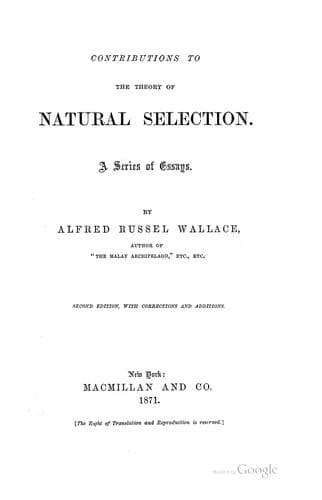
Contributions to the Theory of Natural Selection: A Series of EssaysWallace, Alfred Russel
Science
Contributions to the Theory of Natural Selection: A Series of Essays
Wallace, Alfred Russel
Natural selection
To some persons it will perhaps appear, that the causes to which I
impute so much of the external aspect of nature are too simple, too
insignificant, and too unimportant for such a mighty work. But I would
ask them to consider, that the great object of all the peculiarities of
animal structure is to preserve the life of the individual, and to
maintain the existence of the species. Colour has hitherto been too
often looked upon as something adventitious and superficial, something
given to an animal not to be useful to itself, but solely to gratify man
or even superior beings--to add to the beauty and ideal harmony of
nature. If this were the case, then, it is evident that the colours of
organised beings would be an exception to most other natural phenomena.
They would not be the product of general laws, or determined by
ever-changing external conditions; and we must give up all enquiry into
their origin and causes, since (by the hypothesis) they are dependent on
a Will whose motives must ever be unknown to us. But, strange to say, no
sooner do we begin to examine and classify the colours of natural
objects, than we find that they are intimately related to a variety of
other phenomena, and are, like them, strictly subordinated to general
laws. I have here attempted to elucidate some of these laws in the case
of birds, and have shown how the mode of nidification has affected the
colouring of the female sex in this group. I have before shown to how
great an extent, and in how many ways, the need of protection has
determined the colours of insects, and of some groups of reptiles and
mammalia, and I would now call particular attention to the fact that the
gay tints of flowers, so long supposed to be a convincing proof that
colour has been bestowed for other purposes than the good of its
possessor, have been shown by Mr. Darwin to follow the same great law of
utility. Flowers do not often need protection, but very often require
the aid of insects to fertilize them, and maintain their reproductive
powers in the greatest vigour. Their gay colours attract insects, as do
also their sweet odours and honeyed secretions; and that this is the
main function of colour in flowers is shown by the striking fact, that
those flowers which can be perfectly fertilized by the wind, and do not
need the aid of insects, _rarely or never have gaily-coloured flowers_.
Public-domain text, read in full here on John Shaqi.
Reviews
Reviews
No reviews yet
Be the first to share your thoughts on this work.
Elsewhere in the archive
Join the Discussion
Join the discussion
Sign in to leave a comment or review.
Sign InorCreate an account