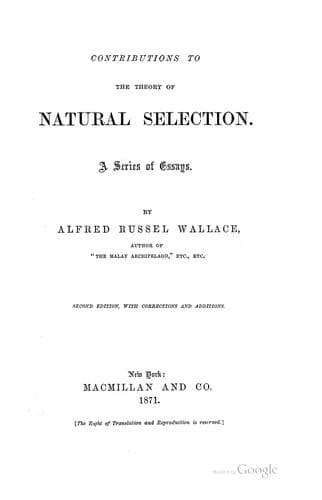
Contributions to the Theory of Natural Selection: A Series of EssaysWallace, Alfred Russel
Science
Contributions to the Theory of Natural Selection: A Series of Essays
Wallace, Alfred Russel
Natural selection
Now there is a difficulty in this view of the origin of the structure of
Orchids which the Duke does not allude to. The majority of flowering
plants are fertilized, either without the agency of insects or, when
insects are required, without any very important modification of the
structure of the flower. It is evident, therefore, that flowers might
have been formed as varied, fantastic, and beautiful as the Orchids, and
yet have been fertilized without more complexity of structure than is
found in Violets, or Clover, or Primroses, or a thousand other flowers.
The strange springs and traps and pitfalls found in the flowers of
Orchids cannot be necessary _per se_, since exactly the same end is
gained in ten thousand other flowers which do not possess them. Is it
not then an extraordinary idea, to imagine the Creator of the Universe
_contriving_ the various complicated parts of these flowers, as a
mechanic might contrive an ingenious toy or a difficult puzzle? Is it
not a more worthy conception that they are some of the results of those
general laws which were so co-ordinated at the first introduction of
life upon the earth as to result necessarily in the utmost possible
development of varied forms?
But let us take one of the simpler cases adduced and see if our general
laws are unable to account for it.
_A Case of Orchis-structure explained by Natural Selection._
There is a Madagascar Orchis--the Angraecum sesquipedale--with an
immensely long and deep nectary. How did such an extraordinary organ
come to be developed? Mr. Darwin's explanation is this. The pollen of
this flower can only be removed by the base of the proboscis of some
very large moths, when trying to get at the nectar at the bottom of the
vessel. The moths with the longest probosces would do this most
effectually; they would be rewarded for their long tongues by getting
the most nectar; whilst on the other hand, the flowers with the deepest
nectaries would be the best fertilized by the largest moths preferring
them. Consequently, the deepest nectaried Orchids and the longest
tongued moths would each confer on the other an advantage in the battle
of life. This would tend to their respective perpetuation, and to the
constant lengthening of nectaries and probosces. Now let it be
remembered, that what we have to account for, is only the unusual length
of this organ. A nectary is found in many orders of plants and is
especially common in the Orchids, but in this one case only is it more
than a foot long. How did this arise? We begin with the fact, proved
experimentally by Mr. Darwin, that moths do visit Orchids, do thrust
their spiral trunks into the nectaries, and do fertilize them by
carrying the pollinia of one flower to the stigma of another. He has
further explained the exact mechanism by which this is effected, and
the Duke of Argyll admits the accuracy of his observations. In our
British species, such as Orchis pyramidalis, it is not necessary that
Public-domain text, read in full here on John Shaqi.
Reviews
Reviews
No reviews yet
Be the first to share your thoughts on this work.
Elsewhere in the archive
Join the Discussion
Join the discussion
Sign in to leave a comment or review.
Sign InorCreate an account