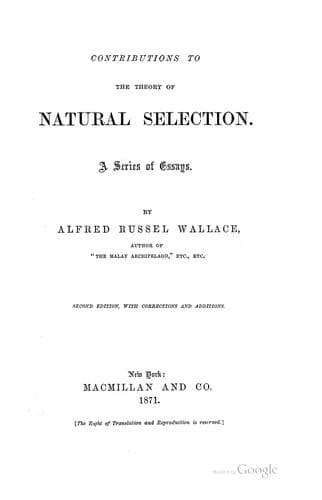
Contributions to the Theory of Natural Selection: A Series of EssaysWallace, Alfred Russel
Science
Contributions to the Theory of Natural Selection: A Series of Essays
Wallace, Alfred Russel
Natural selection
sesquipedale, whose nectaries vary in length from ten to fourteen
inches. That such a moth exists in Madagascar may be safely predicted;
and naturalists who visit that island should search for it with as much
confidence as Astronomers searched for the planet Neptune,--and I
venture to predict they will be equally successful!
Now, instead of this beautiful self-acting adjustment, the opposing
theory is, that the Creator of the Universe, by a direct act of his
Will, so disposed the natural forces influencing the growth of this one
species of plant as to cause its nectary to increase to this enormous
length; and at the same time, by an equally special act, determined the
flow of nourishment in the organization of the moth, so as to cause its
proboscis to increase in exactly the same proportion, having previously
so constructed the Angraecum that it could only be maintained in
existence by the agency of this moth. But what proof is given or
suggested that this was the mode by which the adjustment took place?
None whatever, except a feeling that there is an adjustment of a
delicate kind, and an inability to see how known causes could have
produced such an adjustment. I believe I have shown, however, that such
an adjustment is not only possible but inevitable, unless at some point
or other we deny the action of those simple laws which we have already
admitted to be but the expressions of existing facts.
_Adaptation brought about by General Laws._
It is difficult to find anything like parallel cases in inorganic
nature, but that of a river may perhaps illustrate the subject in some
degree. Let us suppose a person totally ignorant of Modern Geology to
study carefully a great River System. He finds in its lower part, a deep
broad channel filled to the brim, flowing slowly through a flat country
and carrying out to the sea a quantity of fine sediment. Higher up it
branches into a number of smaller channels, flowing alternately through
flat valleys and between high banks; sometimes he finds a deep rocky bed
with perpendicular walls, carrying the water through a chain of hills;
where the stream is narrow he finds it deep, where wide shallow. Further
up still, he comes to a mountainous region, with hundreds of streams and
rivulets, each with its tributary rills and gullies, collecting the
water from every square mile of surface, and every channel adapted to
the water that it has to carry. He finds that the bed of every branch,
and stream, and rivulet, has a steeper and steeper slope as it
approaches its sources, and is thus enabled to carry off the water from
heavy rains, and to bear away the stones and pebbles and gravel, that
would otherwise block up its course. In every part of this system he
would see exact adaptation of means to an end. He would say, that this
system of channels must have been designed, it answers its purpose so
effectually. Nothing but a mind could have so exactly adapted the slopes
Public-domain text, read in full here on John Shaqi.
Reviews
Reviews
No reviews yet
Be the first to share your thoughts on this work.
Elsewhere in the archive
Join the Discussion
Join the discussion
Sign in to leave a comment or review.
Sign InorCreate an account