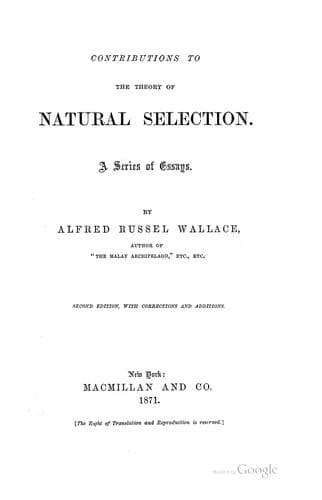
Contributions to the Theory of Natural Selection: A Series of EssaysWallace, Alfred Russel
Science
Contributions to the Theory of Natural Selection: A Series of Essays
Wallace, Alfred Russel
Natural selection
Exactly the same thing occurs in organic nature. We see some one
wonderful case of adjustment, some unusual development of an organ, but
we pass over the hundreds of cases in which that adjustment and
development do not occur. No doubt when one adjustment is absent another
takes its place, because no organism can continue to exist that is not
adjusted to its environment; and unceasing variation with unlimited
powers of multiplication, in most cases, furnish the means of
self-adjustment. The world is so constituted, that by the action of
general laws there is produced the greatest possible variety of surface
and of climate; and by the action of laws equally general, the greatest
possible variety of organisms have been produced, adapted to the varied
conditions of every part of the earth. Tho objector would probably
himself admit, that the varied surface of the earth--the plains and
valleys, the hills and mountains, the deserts and volcanoes, the winds
and currents, the seas and lakes and rivers, and the various climates of
the earth--are all the results of general laws acting and re-acting
during countless ages; and that the Creator does not appear to guide and
control the action of these laws--here determining the height of a
mountain, there altering the channel of a river--here making the rains
more abundant, there changing the direction of a current. He would
probably admit that the forces of inorganic nature are self-adjusting,
and that the result necessarily fluctuates about a given mean condition
(which is itself slowly changing), while within certain limits the
greatest possible amount of variety is produced. If then a "contriving
mind" is not necessary at every step of the process of change eternally
going on in the inorganic world, why are we required to believe in the
continual action of such a mind in the region of organic nature? True,
the laws at work are more complex, the adjustments more delicate, the
appearance of special adaptation more remarkable; but why should we
measure the creative mind by our own? Why should we suppose the machine
too complicated, to have been designed by the Creator so complete that
it would necessarily work out harmonious results? The theory of
"continual interference" is a limitation of the Creator's power. It
assumes that he could not work by pure law in the organic, as he has
done in the inorganic world; it assumes that he could not foresee the
consequences of the laws of matter and mind combined--that results would
continually arise which are contrary to what is best, and that he has to
change what would otherwise be the course of nature, in order to produce
that beauty, and variety, and harmony, which even we, with our limited
intellects, can conceive to be the result of self-adjustment in a
universe governed by unvarying law. If we could not conceive the world
of nature to be self-adjusting and capable of endless development, it
would even then be an unworthy idea of a Creator, to impute the
Public-domain text, read in full here on John Shaqi.
Reviews
Reviews
No reviews yet
Be the first to share your thoughts on this work.
Elsewhere in the archive
Join the Discussion
Join the discussion
Sign in to leave a comment or review.
Sign InorCreate an account