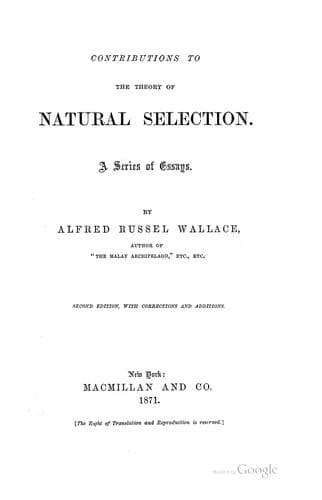
Contributions to the Theory of Natural Selection: A Series of EssaysWallace, Alfred Russel
Science
Contributions to the Theory of Natural Selection: A Series of Essays
Wallace, Alfred Russel
Natural selection
green tints on the upper surface of so many female humming birds, which
are most conducive to their protection while the important functions of
hatching and rearing the young are being carried on. Keeping in mind the
laws of multiplication, variation, and survival of the fittest, which
are for ever in action, these varied developments of beauty and
harmonious adjustments to conditions, are not only conceivable but
demonstrable results.
The objection I am now combating is solely founded on the supposed
analogy of the Creator's mind to ours, as regards the love of Beauty for
its own sake; but if this analogy is to be trusted, then there ought to
be no natural objects which are disagreeable or ungraceful in our eyes.
And yet it is undoubtedly the fact that there are many such. Just as
surely as the Horse and Deer are beautiful and graceful, the Elephant,
Rhinoceros, Hippopotamus, and Camel are the reverse. The majority of
Monkeys and Apes are not beautiful; the majority of Birds have no beauty
of colour; a vast number of Insects and Reptiles are positively ugly.
Now, if the Creator's mind is like ours, whence this ugliness? It is
useless to say "that is a mystery we cannot explain," because we have
attempted to explain one-half of creation by a method that will not
apply to the other half. We know that a man with the highest taste and
with unlimited wealth, practically does abolish all ungraceful and
disagreeable forms and colours from his own domains. If the beauty of
creation is to be explained by the Creator's love of beauty, we are
bound to ask why he has not banished deformity from the earth, as the
wealthy and enlightened man does from his estate and from his dwelling;
and if we can get no satisfactory answer, we shall do well to reject the
explanation offered. Again, in the case of flowers, which are always
especially referred to, as the surest evidence of beauty being an end of
itself in creation, the whole of the facts are never fairly met. At
least half the plants in the world have not bright-coloured or beautiful
flowers; and Mr. Darwin has lately arrived at the wonderful
generalization, that flowers have become beautiful solely to attract
insects to assist in their fertilization. He adds, "I have come to this
conclusion from finding it an invariable rule, that when a flower is
fertilized by the wind it never has a gaily-coloured corolla." Here is a
most wonderful case of beauty being _useful_, when it might be least
expected. But much more is proved; for when beauty is of no use to the
plant it is not given. It cannot be imagined to do any harm. It is
simply not necessary, and is therefore withheld! We ought surely to have
been told how this fact is consistent with beauty being "an end in
itself," and with the statement of its being given to natural objects
"for its own sake."
_How new Forms are produced by Variation and Selection._
Let us now consider another of the popular objections which the Duke of
Argyll thus sets forth:--
Public-domain text, read in full here on John Shaqi.
Reviews
Reviews
No reviews yet
Be the first to share your thoughts on this work.
Elsewhere in the archive
Join the Discussion
Join the discussion
Sign in to leave a comment or review.
Sign InorCreate an account