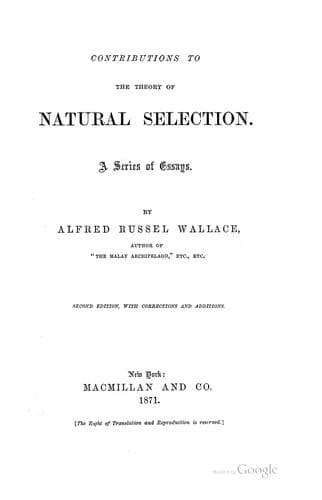
Contributions to the Theory of Natural Selection: A Series of EssaysWallace, Alfred Russel
Science
Contributions to the Theory of Natural Selection: A Series of Essays
Wallace, Alfred Russel
Natural selection
Now this great mass of facts, of which a mere sketch has been here
given, are fully accounted for by the "Law of Variation" as laid down at
the commencement of this paper. Universal variability--small in amount
but in every direction, ever fluctuating about a mean condition until
made to advance in a given direction by "election," natural or
artificial,--is the simple basis for the indefinite modification of the
forms of life;--partial, unbalanced, and consequently unstable
modifications being produced by man, while those developed under the
unrestrained action of natural laws, are at every step self-adjusted to
external conditions by the dying out of all unadjusted forms, and are
therefore stable and comparatively permanent. To be consistent in their
views, our opponents must maintain that every one of the variations that
have rendered possible the changes produced by man, have been determined
at the right time and place by the will of the Creator. Every race
produced by the florist or the breeder, the dog or the pigeon fancier,
the ratcatcher, the sporting man, or the slave-hunter, must have been
provided for by varieties occurring when wanted; and as these variations
were never withheld, it would prove, that the sanction of an all-wise
and all-powerful Being, has been given to that which the highest human
minds consider to be trivial, mean, or debasing.
This appears to be a complete answer to the theory, that variation
sufficient in amount to be accumulated in a given direction must be the
direct act of the Creative Mind, but it is also sufficiently condemned
by being so entirely unnecessary. The facility with which man obtains
new races, depends chiefly upon the number of individuals he can procure
to select from. When hundreds of florists or breeders are all aiming at
the same object, the work of change goes on rapidly. But a common
species in nature contains a thousand-or a million-fold more individuals
than any domestic race; and survival of the fittest must unerringly
preserve all that vary in the right direction, not only in obvious
characters but in minute details, not only in external but in internal
organs; so that if the materials are sufficient for the needs of man,
there can be no want of them to fulfil the grand purpose of keeping up a
supply of modified organisms, exactly adapted to the changed conditions
that are always occurring in the inorganic world.
_The Objection that there are Limits to Variation._
Public-domain text, read in full here on John Shaqi.
Reviews
Reviews
No reviews yet
Be the first to share your thoughts on this work.
Elsewhere in the archive
Join the Discussion
Join the discussion
Sign in to leave a comment or review.
Sign InorCreate an account