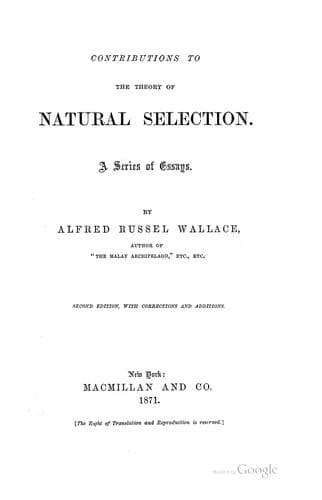
Contributions to the Theory of Natural Selection: A Series of EssaysWallace, Alfred Russel
Science
Contributions to the Theory of Natural Selection: A Series of Essays
Wallace, Alfred Russel
Natural selection
Again, when any slow changes of physical geography, or of climate, make
it necessary for an animal to alter its food, its clothing, or its
weapons, it can only do so by the occurrence of a corresponding change
in its own bodily structure and internal organization. If a larger or
more powerful beast is to be captured and devoured, as when a
carnivorous animal which has hitherto preyed on antelopes is obliged
from their decreasing numbers to attack buffaloes, it is only the
strongest who can hold,--those with most powerful claws, and formidable
canine teeth, that can struggle with and overcome such an animal.
Natural selection immediately comes into play, and by its action these
organs gradually become adapted to their new requirements. But man,
under similar circumstances, does not require longer nails or teeth,
greater bodily strength or swiftness. He makes sharper spears, or a
better bow, or he constructs a cunning pitfall, or combines in a hunting
party to circumvent his new prey. The capacities which enable him to do
this are what he requires to be strengthened, and these will, therefore,
be gradually modified by "natural selection," while the form and
structure of his body will remain unchanged. So, when a glacial epoch
comes on, some animals must acquire warmer fur, or a covering of fat, or
else die of cold. Those best clothed by nature are, therefore, preserved
by natural selection. Man, under the same circumstances, will make
himself warmer clothing, and build better houses; and the necessity of
doing this will react upon his mental organization and social
condition--will advance them while his natural body remains naked as
before.
When the accustomed food of some animal becomes scarce or totally fails,
it can only exist by becoming adapted to a new kind of food, a food
perhaps less nourishing and less digestible. "Natural selection" will
now act upon the stomach and intestines, and all their individual
variations will be taken advantage of, to modify the race into harmony
with its new food. In many cases, however, it is probable that this
cannot be done. The internal organs may not vary quick enough, and then
the animal will decrease in numbers, and finally become extinct. But
man guards himself from such accidents by superintending and guiding the
operations of nature. He plants the seed of his most agreeable food, and
thus procures a supply, independent of the accidents of varying seasons
or natural extinction. He domesticates animals, which serve him either
to capture food or for food itself, and thus, changes of any great
extent in his teeth or digestive organs are rendered unnecessary. Man,
too, has everywhere the use of fire, and by its means can render
palatable a variety of animal and vegetable substances, which he could
hardly otherwise make use of; and thus obtains for himself a supply of
food far more varied and abundant than that which any animal can
command.
Public-domain text, read in full here on John Shaqi.
Reviews
Reviews
No reviews yet
Be the first to share your thoughts on this work.
Elsewhere in the archive
Join the Discussion
Join the discussion
Sign in to leave a comment or review.
Sign InorCreate an account