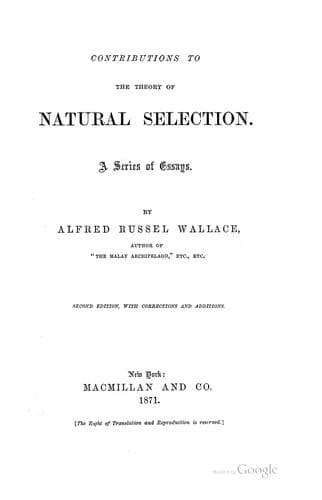
Contributions to the Theory of Natural Selection: A Series of EssaysWallace, Alfred Russel
Science
Contributions to the Theory of Natural Selection: A Series of Essays
Wallace, Alfred Russel
Natural selection
We now find ourselves enabled to answer those who maintain, that if Mr.
Darwin's theory of the Origin of Species is true, man too must change in
form, and become developed into some other animal as different from his
present self as he is from the Gorilla or the Chimpanzee; and who
speculate on what this form is likely to be. But it is evident that such
will not be the case; for no change of conditions is conceivable, which
will render any important alteration of his form and organization so
universally useful and necessary to him, as to give those possessing it
always the best chance of surviving, and thus lead to the development
of a new species, genus, or higher group of man. On the other hand, we
know that far greater changes of conditions and of his entire
environment have been undergone by man, than any other highly organized
animal could survive unchanged, and have been met by mental, not
corporeal adaptation. The difference of habits, of food, clothing,
weapons, and enemies, between savage and civilized man, is enormous.
Difference in bodily form and structure there is practically none,
except a slightly increased size of brain, corresponding to his higher
mental development.
We have every reason to believe, then, that man may have existed and may
continue to exist, through a series of geological periods which shall
see all other forms of animal life again and again changed; while he
himself remains unchanged, except in the two particulars already
specified--the head and face, as immediately connected with the organ of
the mind and as being the medium of expressing the most refined emotions
of his nature,--and to a slight extent in colour, hair, and proportions,
so far as they are correlated with constitutional resistance to disease.
_Summary._
Briefly to recapitulate the argument;--in two distinct ways has man
escaped the influence of those laws which have produced unceasing change
in the animal world. 1. By his superior intellect he is enabled to
provide himself with clothing and weapons, and by cultivating the soil
to obtain a constant supply of congenial food. This renders it
unnecessary for his body, like those of the lower animals, to be
modified in accordance with changing conditions--to gain a warmer
natural covering, to acquire more powerful teeth or claws, or to become
adapted to obtain and digest new kinds of food, as circumstances may
require. 2. By his superior sympathetic and moral feelings, he becomes
fitted for the social state; he ceases to plunder the weak and helpless
of his tribe; he shares the game which he has caught with less active or
less fortunate hunters, or exchanges it for weapons which even the weak
or the deformed can fashion; he saves the sick and wounded from death;
and thus the power which leads to the rigid destruction of all animals
who cannot in every respect help themselves, is prevented from acting on
him.
Public-domain text, read in full here on John Shaqi.
Reviews
Reviews
No reviews yet
Be the first to share your thoughts on this work.
Elsewhere in the archive
Join the Discussion
Join the discussion
Sign in to leave a comment or review.
Sign InorCreate an account