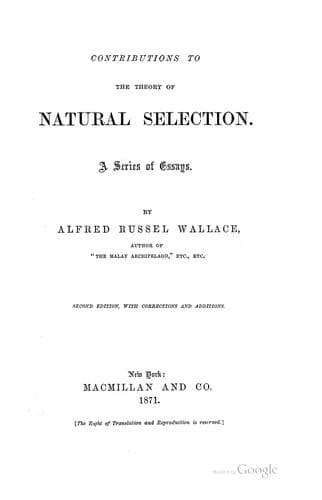
Contributions to the Theory of Natural Selection: A Series of EssaysWallace, Alfred Russel
Science
Contributions to the Theory of Natural Selection: A Series of Essays
Wallace, Alfred Russel
Natural selection
Other characters show difficulties of a similar kind, though not perhaps
in an equal degree. The structure of the human foot and hand seem
unnecessarily perfect for the needs of savage man, in whom they are as
completely and as humanly developed as in the highest races. The
structure of the human larynx, giving the power of speech and of
producing musical sounds, and especially its extreme development in the
female sex, are shown to be beyond the needs of savages, and from their
known habits, impossible to have been acquired either by sexual
selection, or by survival of the fittest.
The mind of man offers arguments in the same direction, hardly less
strong than those derived from his bodily structure. A number of his
mental faculties have no relation to his fellow men, or to his material
progress. The power of conceiving eternity and infinity, and all those
purely abstract notions of form, number, and harmony, which play so
large a part in the life of civilised races, are entirely outside of the
world of thought of the savage, and have no influence on his individual
existence or on that of his tribe. They could not, therefore, have been
developed by any preservation of useful forms of thought; yet we find
occasional traces of them amidst a low civilization, and at a time when
they could have had no practical effect on the success of the
individual, the family, or the race; and the development of a moral
sense or conscience by similar means is equally inconceivable.
But, on the other hand, we find that every one of these characteristics
is necessary for the full development of human nature. The rapid
progress of civilization under favourable conditions, would not be
possible, were not the organ of the mind of man prepared in advance,
fully developed as regards size, structure, and proportions, and only
needing a few generations of use and habit to co-ordinate its complex
functions. The naked and sensitive skin, by necessitating clothing and
houses, would lead to the more rapid development of man's inventive and
constructive faculties; and, by leading to a more refined feeling of
personal modesty, may have influenced, to a considerable extent, his
moral nature. The erect form of man, by freeing the hands from all
locomotive uses, has been necessary for his intellectual advancement;
and the extreme perfection of his hands, has alone rendered possible
that excellence in all the arts of civilization which raises him so far
above the savage, and is perhaps but the forerunner of a higher
intellectual and moral advancement. The perfection of his vocal organs
has first led to the formation of articulate speech, and then to the
development of those exquisitely toned sounds, which are only
appreciated by the higher races, and which are probably destined for
more elevated uses and more refined enjoyment, in a higher condition
than we have yet attained to. So, those faculties which enable us to
Public-domain text, read in full here on John Shaqi.
Reviews
Reviews
No reviews yet
Be the first to share your thoughts on this work.
Elsewhere in the archive
Join the Discussion
Join the discussion
Sign in to leave a comment or review.
Sign InorCreate an account