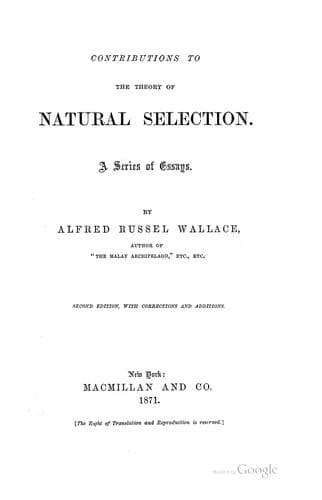
Contributions to the Theory of Natural Selection: A Series of EssaysWallace, Alfred Russel
Science
Contributions to the Theory of Natural Selection: A Series of Essays
Wallace, Alfred Russel
Natural selection
It has been long seen by the best thinkers on the subject, that
atoms,--considered as minute solid bodies from which emanate the
attractive and repulsive forces which give what we term matter its
properties,--could serve no purpose whatever; since it is universally
admitted that the supposed atoms never touch each other, and it cannot
be conceived that these homogeneous, indivisible, solid units, are
themselves the ultimate _cause_ of the forces that emanate from their
centres. As, therefore, none of the properties of matter can be due to
the atoms themselves, but only to the forces which emanate from the
points in space indicated by the atomic centres, it is logical
continually to diminish their size till they vanish, leaving only
localized centres of force to represent them. Of the various attempts
that have been made to show how the properties of matter may be due to
such modified atoms (considered as mere centres of force), the most
successful, because the simplest and the most logical, is that of Mr.
Bayma, who, in his "Molecular Mechanics," has demonstrated how, from the
simple assumption of such centres having attractive and repulsive forces
(both varying according to the same law of the inverse squares as
gravitation), and by grouping them in symmetrical figures, consisting of
a repulsive centre, an attractive nucleus, and one or more repulsive
envelopes, we may explain all the general properties of matter; and, by
more and more complex arrangements, even the special chemical,
electrical, and magnetic properties of special forms of matter.[I] Each
chemical element will thus consist of a molecule formed of simple atoms,
(or as Mr. Bayma terms them to avoid confusion, "material elements") in
greater or less number and of more or less complex arrangement; which
molecule is in stable equilibrium, but liable to be changed in form by
the attractive or repulsive influences of differently constituted
molecules, constituting the phenomena of chemical combination, and
resulting in new forms of molecule of greater complexity and more or
less stability.
Public-domain text, read in full here on John Shaqi.
Reviews
Reviews
No reviews yet
Be the first to share your thoughts on this work.
Elsewhere in the archive
Join the Discussion
Join the discussion
Sign in to leave a comment or review.
Sign InorCreate an account