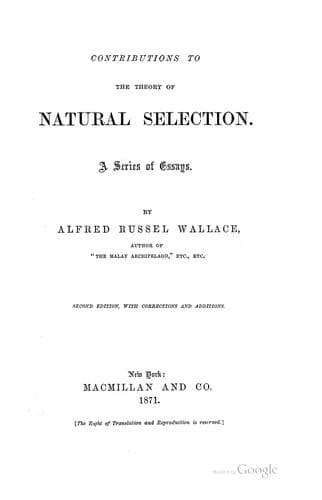
Contributions to the Theory of Natural Selection: A Series of EssaysWallace, Alfred Russel
Science
Contributions to the Theory of Natural Selection: A Series of Essays
Wallace, Alfred Russel
Natural selection
A friend has suggested that I have not here explained myself
sufficiently, and objects, that _life_ does not exist in matter any more
than _consciousness_, and if the one can be produced by the laws of
matter, why may not the other? I reply, that there is a radical
difference between the two. Organic or vegetative life consists
essentially in chemical transformations and molecular motions, occurring
under certain conditions and in a certain order. The matter, and the
forces which act upon it, are for the most part known; and if there are
any forces engaged in the manifestation of vegetative life yet
undiscovered (which is a moot question), we can conceive them as
analogous to such forces as heat, electricity, or chemical affinity,
with which we are already acquainted. We can thus clearly _conceive_ of
the transition from dead matter to living matter. A complex mass which
suffers decomposition or decay is dead, but if this mass has the power
of attracting to itself, from the surrounding medium, matter like that
of which it is composed, we have the first rudiment of vegetative life.
If the mass can do this for a considerable time, and if its absorption
of new matter more than replaces that lost by decomposition, and if it
is of such a nature as to resist the mechanical or chemical forces to
which it is usually exposed, and to retain a tolerably constant form, we
term it a living organism. We can _conceive_ an organism to be so
constituted, and we can further conceive that any fragments, which may
be accidentally broken from it, or which may fall away when its bulk has
become too great for the cohesion of all its parts, may begin to
increase anew and run the same course as the parent mass. This is growth
and reproduction in their simplest forms; and from such a simple
beginning it is possible to conceive a series of slight modifications of
composition, and of internal and external forces, which should
ultimately lead to the development of more complex organisms. The LIFE
of such an organism may, perhaps, be nothing added to it, but merely the
name we give to the result of a balance of internal and external forces
in maintaining the permanence of the form and structure of the
individual. The simplest conceivable form of such life would be the
dewdrop, which owes its existence to the balance between the
condensation of aqueous vapour in the atmosphere and the evaporation of
its substance. If either is in excess, it soon ceases to maintain an
individual existence. I do not maintain that vegetative life _is_ wholly
due to such a complex balance of forces, but only that it is
_conceivable_ as such.
Public-domain text, read in full here on John Shaqi.
Reviews
Reviews
No reviews yet
Be the first to share your thoughts on this work.
Elsewhere in the archive
Join the Discussion
Join the discussion
Sign in to leave a comment or review.
Sign InorCreate an account