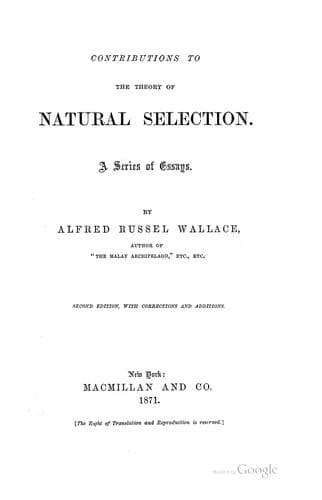
Contributions to the Theory of Natural Selection: A Series of EssaysWallace, Alfred Russel
Science
Contributions to the Theory of Natural Selection: A Series of Essays
Wallace, Alfred Russel
Natural selection
It has been long known to entomologists that certain insects bear a
strange external resemblance to others belonging to distinct genera,
families, or even orders, and with which they have no real affinity
whatever. The fact, however, appears to have been generally considered
as dependent upon some unknown law of "analogy"--some "system of
nature," or "general plan," which had guided the Creator in designing
the myriads of insect forms, and which we could never hope to
understand. In only one case does it appear that the resemblance was
thought to be useful, and to have been designed as a means to a definite
and intelligible purpose. The flies of the genus Volucella enter the
nests of bees to deposit their eggs, so that their larvae may feed upon
the larvae of the bees, and these flies are each wonderfully like the bee
on which it is parasitic. Kirby and Spence believed that this
resemblance or "mimicry" was for the express purpose of protecting the
flies from the attacks of the bees, and the connection is so evident
that it was hardly possible to avoid this conclusion. The resemblance,
however, of moths to butterflies or to bees, of beetles to wasps, and of
locusts to beetles, has been many times noticed by eminent writers; but
scarcely ever till within the last few years does it appear to have been
considered that these resemblances had any special purpose, or were of
any direct benefit to the insects themselves. In this respect they were
looked upon as accidental, as instances of the "curious analogies" in
nature which must be wondered at but which could not be explained.
Recently, however, these instances have been greatly multiplied; the
nature of the resemblances has been more carefully studied, and it has
been found that they are often carried out into such details as almost
to imply a purpose of deceiving the observer. The phenomena, moreover,
have been shown to follow certain definite laws, which again all
indicate their dependence on the more general law of the "survival of
the fittest," or "the preservation of favoured races in the struggle for
life." It will, perhaps, be as well here to state what these laws or
general conclusions are, and then to give some account of the facts
which support them.
The first law is, that in an overwhelming majority of cases of mimicry,
the animals (or the groups) which resemble each other inhabit the same
country, the same district, and in most cases are to be found together
on the very same spot.
The second law is, that these resemblances are not indiscriminate, but
are limited to certain groups, which in every case are abundant in
species and individuals, and can often be ascertained to have some
special protection.
The third law is, that the species which resemble or "mimic" these
dominant groups, are comparatively less abundant in individuals, and are
often very rare.
Public-domain text, read in full here on John Shaqi.
Reviews
Reviews
No reviews yet
Be the first to share your thoughts on this work.
Elsewhere in the archive
Join the Discussion
Join the discussion
Sign in to leave a comment or review.
Sign InorCreate an account