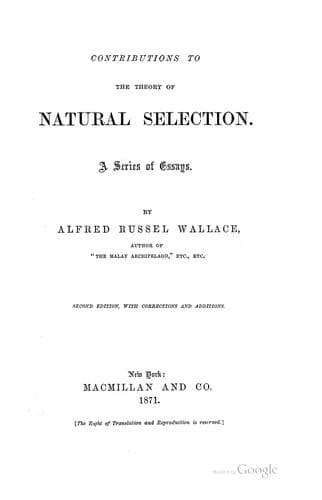
Contributions to the Theory of Natural Selection: A Series of EssaysWallace, Alfred Russel
Science
Contributions to the Theory of Natural Selection: A Series of Essays
Wallace, Alfred Russel
Natural selection
These laws will be found to hold good, in all the cases of true mimicry
among various classes of animals to which we have now to call the
attention of our readers.
_Mimicry among Lepidoptera._
As it is among butterflies that instances of mimicry are most numerous
and most striking, an account of some of the more prominent examples in
this group will first be given. There is in South America an extensive
family of these insects, the Heliconidae, which are in many respects very
remarkable. They are so abundant and characteristic in all the woody
portions of the American tropics, that in almost every locality they
will be seen more frequently than any other butterflies. They are
distinguished by very elongate wings, body, and antennae, and are
exceedingly beautiful and varied in their colours; spots and patches of
yellow, red, or pure white upon a black, blue, or brown ground, being
most general. They frequent the forests chiefly, and all fly slowly and
weakly; yet although they are so conspicuous, and could certainly be
caught by insectivorous birds more easily than almost any other
insects, their great abundance all over the wide region they inhabit
shows that they are not so persecuted. It is to be especially remarked
also, that they possess no adaptive colouring to protect them during
repose, for the under side of their wings presents the same, or at least
an equally conspicuous colouring as the upper side; and they may be
observed after sunset suspended at the end of twigs and leaves where
they have taken up their station for the night, fully exposed to the
attacks of enemies if they have any. These beautiful insects possess,
however, a strong pungent semi-aromatic or medicinal odour, which seems
to pervade all the juices of their system. When the entomologist
squeezes the breast of one of them between his fingers to kill it, a
yellow liquid exudes which stains the skin, and the smell of which can
only be got rid of by time and repeated washings. Here we have probably
the cause of their immunity from attack, since there is a great deal of
evidence to show that certain insects are so disgusting to birds that
they will under no circumstances touch them. Mr. Stainton has observed
that a brood of young turkeys greedily devoured all the worthless moths
he had amassed in a night's "sugaring," yet one after another seized and
rejected a single white moth which happened to be among them. Young
pheasants and partridges which eat many kinds of caterpillars seem to
have an absolute dread of that of the common currant moth, which they
will never touch, and tomtits as well as other small birds appear never
to eat the same species. In the case of the Heliconidae, however, we
have some direct evidence to the same effect. In the Brazilian forests
there are great numbers of insectivorous birds--as jacamars, trogons,
and puffbirds--which catch insects on the wing, and that they destroy
many butterflies is indicated by the fact that the wings of these
Public-domain text, read in full here on John Shaqi.
Reviews
Reviews
No reviews yet
Be the first to share your thoughts on this work.
Elsewhere in the archive
Join the Discussion
Join the discussion
Sign in to leave a comment or review.
Sign InorCreate an account