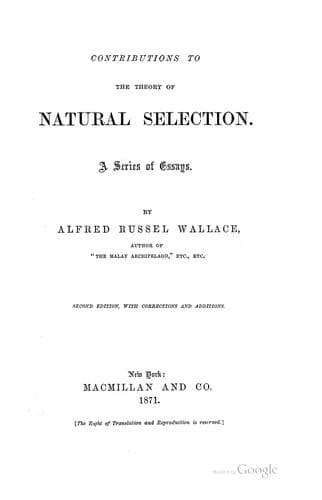
Contributions to the Theory of Natural Selection: A Series of EssaysWallace, Alfred Russel
Science
Contributions to the Theory of Natural Selection: A Series of Essays
Wallace, Alfred Russel
Natural selection
In other parts of the world an exactly parallel series of facts have
been observed. The Danaidae and the Acraeidae of the Old World tropics form
in fact one great group with the Heliconidae. They have the same general
form, structure, and habits: they possess the same protective odour, and
are equally abundant in individuals, although not so varied in colour,
blue and white spots on a black ground being the most general pattern.
The insects which mimic these are chiefly Papilios, and Diadema, a genus
allied to our peacock and tortoiseshell butterflies. In tropical Africa
there is a peculiar group of the genus Danais, characterized by
dark-brown and bluish-white colours, arranged in bands or stripes. One
of these, Danais niavius, is exactly imitated both by Papilio hippocoon
and by Diadema anthedon; another, Danais echeria, by Papilio cenea; and
in Natal a variety of the Danais is found having a white spot at the tip
of wings, accompanied by a variety of the Papilio bearing a
corresponding white spot. Acraea gea is copied in its very peculiar style
of colouration by the female of Papilio cynorta, by Panopaea hirce, and
by the female of Elymnias phegea. Acraea euryta of Calabar has a female
variety of Panopea hirce from the same place which exactly copies it;
and Mr. Trimen, in his paper on Mimetic Analogies among African
Butterflies, published in the Transactions of the Linnaean Society for
1868, gives a list of no less than sixteen species and varieties of
Diadema and its allies, and ten of Papilio, which in their colour and
markings are perfect mimics of species or varieties of Danais or Acraea
which inhabit the same districts.
Passing on to India, we have Danais tytia, a butterfly with
semi-transparent bluish wings and a border of rich reddish brown. This
remarkable style of colouring is exactly reproduced in Papilio agestor
and in Diadema nama, and all three insects not unfrequently come
together in collections made at Darjeeling. In the Philippine Islands
the large and curious Idea leuconoee with its semi-transparent white
wings, veined and spotted with black, is copied by the rare Papilio
idaeoides from the same islands.
In the Malay archipelago the very common and beautiful Euploea midamus
is so exactly mimicked by two rare Papilios (P. paradoxa and P. aenigma)
that I generally caught them under the impression that they were the
more common species; and the equally common and even more beautiful
Euploea rhadamanthus, with its pure white bands and spots on a ground of
glossy blue and black, is reproduced in the Papilio caunus. Here also
there are species of Diadema imitating the same group in two or three
instances; but we shall have to adduce these further on in connexion
with another branch of the subject.
Public-domain text, read in full here on John Shaqi.
Reviews
Reviews
No reviews yet
Be the first to share your thoughts on this work.
Elsewhere in the archive
Join the Discussion
Join the discussion
Sign in to leave a comment or review.
Sign InorCreate an account