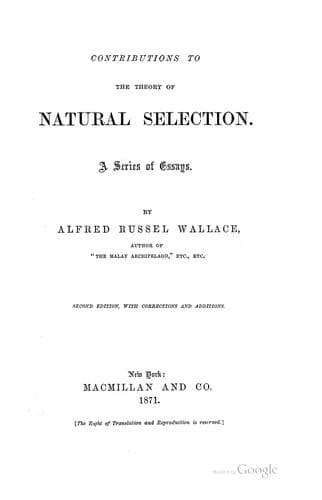
Contributions to the Theory of Natural Selection: A Series of EssaysWallace, Alfred Russel
Science
Contributions to the Theory of Natural Selection: A Series of Essays
Wallace, Alfred Russel
Natural selection
It has been already mentioned that in South America there is a group of
Papilios which have all the characteristics of a protected race, and
whose peculiar colours and markings are imitated by other butterflies
not so protected. There is just such a group also in the East, having
very similar colours and the same habits, and these also are mimicked by
other species in the same genus not closely allied to them, and also by
a few of other families. Papilio hector, a common Indian butterfly of a
rich black colour spotted with crimson, is so closely copied by Papilio
romulus, that the latter insect has been thought to be its female. A
close examination shows, however, that it is essentially different, and
belongs to another section of the genus. Papilio antiphus and P.
diphilus, black swallow-tailed butterflies with cream-coloured spots,
are so well imitated by varieties of P. theseus, that several writers
have classed them as the same species. Papilio liris, found only in the
island of Timor, is accompanied there by P. aenomaus, the female of
which so exactly resembles it that they can hardly be separated in the
cabinet, and on the wing are quite undistinguishable. But one of the
most curious cases is the fine yellow-spotted Papilio coeon, which is
unmistakeably imitated by the female tailed form of Papilio memnon.
These are both from Sumatra; but in North India P. coeon is replaced by
another species, which has been named P. doubledayi, having red spots
instead of yellow; and in the same district the corresponding female
tailed form of Papilio androgeus, sometimes considered a variety of P.
memnon, is similarly red-spotted. Mr. Westwood has described some
curious day-flying moths (Epicopeia) from North India, which have the
form and colour of Papilios of this section, and two of these are very
good imitations of Papilio polydorus and Papilio varuna, also from North
India.
Almost all these cases of mimicry are from the tropics, where the forms
of life are more abundant, and where insect development especially is of
unchecked luxuriance; but there are also one or two instances in
temperate regions. In North America, the large and handsome red and
black butterfly Danais erippus is very common; and the same country is
inhabited by Limenitis archippus, which closely resembles the Danais,
while it differs entirely from every species of its own genus.
Public-domain text, read in full here on John Shaqi.
Reviews
Reviews
No reviews yet
Be the first to share your thoughts on this work.
Elsewhere in the archive
Join the Discussion
Join the discussion
Sign in to leave a comment or review.
Sign InorCreate an account