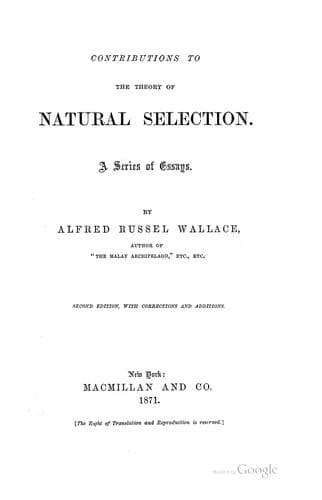
Contributions to the Theory of Natural Selection: A Series of EssaysWallace, Alfred Russel
Science
Contributions to the Theory of Natural Selection: A Series of Essays
Wallace, Alfred Russel
Natural selection
There is a genus of small spiders in the tropics which feed on ants, and
they are exactly like ants themselves, which no doubt gives them more
opportunity of seizing their prey; and Mr. Bates found on the Amazon a
species of Mantis which exactly resembled the white ants which it fed
upon, as well as several species of crickets (Scaphura), which resembled
in a wonderful manner different sand-wasps of large size, which are
constantly on the search for crickets with which to provision their
nests.
Perhaps the most wonderful case of all is the large caterpillar
mentioned by Mr. Bates, which startled him by its close resemblance to a
small snake. The first three segments behind the head were dilatable at
the will of the insect, and had on each side a large black pupillated
spot, which resembled the eye of the reptile. Moreover, it resembled a
poisonous viper, not a harmless species of snake, as was proved by the
imitation of keeled scales on the crown produced by the recumbent feet,
as the caterpillar threw itself backward!
The attitudes of many of the tropical spiders are most extraordinary and
deceptive, but little attention has been paid to them. They often mimic
other insects, and some, Mr. Bates assures us, are exactly like flower
buds, and take their station in the axils of leaves, where they remain
motionless waiting for their prey.
_Cases of Mimicry among the Vertebrata._
Having thus shown how varied and extraordinary are the modes in which
mimicry occurs among insects, we have now to enquire if anything of the
same kind is to be observed among vertebrated animals. When we consider
all the conditions necessary to produce a good deceptive imitation, we
shall see at once that such can very rarely occur in the higher animals,
since they possess none of those facilities for the almost infinite
modifications of external form which exist in the very nature of insect
organization. The outer covering of insects being more or less solid
and horny, they are capable of almost any amount of change of form and
appearance without any essential modification internally. In many groups
the wings give much of the character, and these organs may be much
modified both in form and colour without interfering with their special
functions. Again, the number of species of insects is so great, and
there is such diversity of form and proportion in every group, that the
chances of an accidental approximation in size, form, and colour, of one
insect to another of a different group, are very considerable; and it is
these chance approximations that furnish the basis of mimicry, to be
continually advanced and perfected by the survival of those varieties
only which tend in the right direction.
Public-domain text, read in full here on John Shaqi.
Reviews
Reviews
No reviews yet
Be the first to share your thoughts on this work.
Elsewhere in the archive
Join the Discussion
Join the discussion
Sign in to leave a comment or review.
Sign InorCreate an account