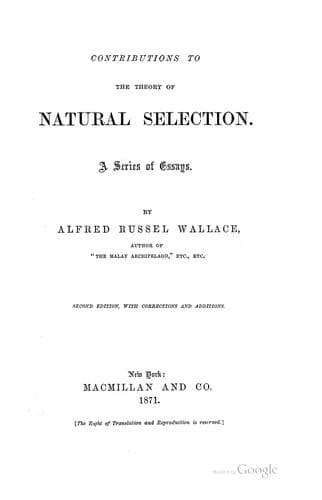
Contributions to the Theory of Natural Selection: A Series of EssaysWallace, Alfred Russel
Science
Contributions to the Theory of Natural Selection: A Series of Essays
Wallace, Alfred Russel
Natural selection
The comparative importance of the sexes varies much in different classes
of animals. In the higher vertebrates, where the number of young
produced at a birth is small and the same individuals breed many years
in succession, the preservation of both sexes is almost equally
important. In all the numerous cases in which the male protects the
female and her offspring, or helps to supply them with food, his
importance in the economy of nature is proportionately increased,
though it is never perhaps quite equal to that of the female. In
insects the case is very different; they pair but once in their lives,
and the prolonged existence of the male is in most cases quite
unnecessary for the continuance of the race. The female, however, must
continue to exist long enough to deposit her eggs in a place adapted for
the development and growth of the progeny. Hence there is a wide
difference in the need for protection in the two sexes; and we should,
therefore, expect to find that in some cases the special protection
given to the female was in the male less in amount or altogether
wanting. The facts entirely confirm this expectation. In the spectre
insects (Phasmidae) it is often the females alone that so strikingly
resemble leaves, while the males show only a rude approximation. The
male Diadema misippus is a very handsome and conspicuous butterfly,
without a sign of protective or imitative colouring, while the female is
entirely unlike her partner, and is one of the most wonderful cases of
mimicry on record, resembling most accurately the common Danais
chrysippus, in whose company it is often found. So in several species of
South American Pieris, the males are white and black, of a similar type
of colouring to our own "cabbage" butterflies, while the females are
rich yellow and buff, spotted and marked so as exactly to resemble
species of Heliconidae with which they associate in the forest. In the
Malay archipelago is found a Diadema which had always been considered a
male insect on account of its glossy metallic-blue tints, while its
companion of sober brown was looked upon as the female. I discovered,
however, that the reverse is the case, and that the rich and glossy
colours of the female are imitative and protective, since they cause her
exactly to resemble the common Euploea midamus of the same regions, a
species which has been already mentioned in this essay as mimicked by
another butterfly, Papilio paradoxa. I have since named this interesting
species Diadema anomala (see the Transactions of the Entomological
Society, 1869, p. 285). In this case, and in that of Diadema misippus,
there is no difference in the habits of the two sexes, which fly in
similar localities; so that the influence of "external conditions"
cannot be invoked here as it has been in the case of the South American
Pieris pyrrha and allies, where the white males frequent open sunny
places, while the Heliconia-like females haunt the shades of the forest.
Public-domain text, read in full here on John Shaqi.
Reviews
Reviews
No reviews yet
Be the first to share your thoughts on this work.
Elsewhere in the archive
Join the Discussion
Join the discussion
Sign in to leave a comment or review.
Sign InorCreate an account