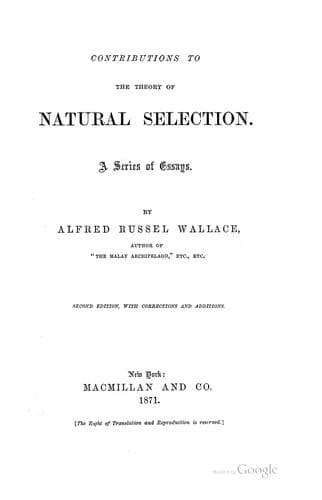
Contributions to the Theory of Natural Selection: A Series of EssaysWallace, Alfred Russel
Science
Contributions to the Theory of Natural Selection: A Series of Essays
Wallace, Alfred Russel
Natural selection
2. _Polymorphism or dimorphism._--By this term I understand the
co-existence in the same locality of two or more distinct forms, not
connected by intermediate gradations, and all of which are occasionally
produced from common parents. These distinct forms generally occur in
the female sex only, and their offspring, instead of being hybrids, or
like the two parents, appear to reproduce all the distinct forms in
varying proportions. I believe it will be found that a considerable
number of what have been classed as _varieties_ are really cases of
polymorphism. Albinoism and melanism are of this character, as well as
most of those cases in which well-marked varieties occur in company with
the parent species, but without any intermediate forms. If these
distinct forms breed independently, and are never reproduced from a
common parent, they must be considered as separate species, contact
without intermixture being a good test of specific difference. On the
other hand, intercrossing without producing an intermediate race is a
test of dimorphism. I consider, therefore, that under any circumstances
the term "variety" is wrongly applied to such cases.
The Malayan Papilionidae exhibit some very curious instances of
polymorphism, some of which have been recorded as varieties, others as
distinct species; and they all occur in the female sex. Papilio Memnon
is one of the most striking, as it exhibits the mixture of simple
variability, local and polymorphic forms, all hitherto classed under the
common title of varieties. The polymorphism is strikingly exhibited by
the females, one set of which resemble the males in form, with a
variable paler colouring; the others have a large spatulate tail to the
hinder wings and a distinct style of colouring, which causes them
closely to resemble P. Coon, a species having the two sexes alike and
inhabiting the same countries, but with which they have no direct
affinity. The tailless females exhibit simple variability, scarcely two
being found exactly alike even in the same locality. The males of the
island of Borneo exhibit constant differences of the under surface, and
may therefore be distinguished as a local form, while the continental
specimens, as a whole, offer such large and constant differences from
those of the islands, that I am inclined to separate them as a distinct
species, to which the name P. Androgeus (Cramer) may be applied. We
have here, therefore, distinct species, local forms, polymorphism, and
simple variability, which seem to me to be distinct phenomena, but which
have been hitherto all classed together as varieties. I may mention that
the fact of these distinct forms being one species is doubly proved. The
males, the tailed and tailless females, have all been bred from a single
group of the larvae, by Messrs. Payen and Bocarme, in Java, and I myself
captured, in Sumatra, a male P. Memnon, and a tailed female P. Achates,
under circumstances which led me to class them as the same species.
Public-domain text, read in full here on John Shaqi.
Reviews
Reviews
No reviews yet
Be the first to share your thoughts on this work.
Elsewhere in the archive
Join the Discussion
Join the discussion
Sign in to leave a comment or review.
Sign InorCreate an account