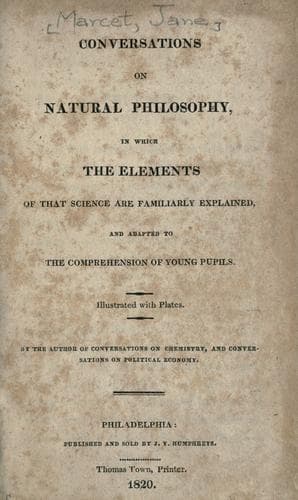
Conversations on Natural Philosophy, in which the Elements of that Science are Familiarly ExplainedMarcet, Mrs. (Jane Haldimand)
Science
Conversations on Natural Philosophy, in which the Elements of that Science are Familiarly Explained
Marcet, Mrs. (Jane Haldimand)
Physics
_Emily._ I believe I guess the reason. There cannot be a reservoir of
water near the summit of a hill; as in such a situation, there will not
be a sufficient number of rivulets formed, to supply one; and without a
reservoir, there can be no spring. In such situations, therefore, it is
necessary to dig very deep, in order to meet with a spring; and when we
give it vent, it can rise only as high as the reservoir from whence it
flows, which will be but little, as the reservoir must be situated at
some considerable depth below the summit of the hill.
_Caroline._ Your explanation appears very clear and satisfactory; but I
can contradict it from experience. At the very top of a hill, near our
country-house, there is a large pond, and, according to your theory, it
would be impossible there should be springs in such a situation to
supply it with water. Then you know that I have crossed the Alps, and I
can assure you, that there is a fine lake on the summit of Mount Cenis,
the highest mountain we passed over.
_Mrs. B._ Were there a lake on the summit of Mount Blanc, which is the
highest of the Alps, it would indeed be wonderful. But that on Mount
Cenis, is not at all contradictory to our theory of springs; for this
mountain is surrounded by others, much more elevated, and the springs
which feed the lake must descend from reservoirs of water, formed in
those mountains. This must also be the case with the pond on the top of
the hill; there is doubtless some more considerable hill in the
neighbourhood, which supplies it with water.
_Emily._ I comprehend perfectly, why the water in our well never rises
high: but I do not understand why it should occasionally be dry.
_Mrs. B._ Because the reservoir from which it flows, being in an
elevated situation, is but scantily supplied with water; after a long
drought, therefore, it may be drained, and the spring dry, till the
reservoir be replenished by fresh rains. It is not uncommon to see
springs flow with great violence in wet seasons, which at other times,
are perfectly dry.
_Caroline._ But there is a spring in our grounds, which more frequently
flows in dry, than in wet weather; how is that to be accounted for?
_Mrs. B._ The spring, probably, comes from a reservoir at a great
distance, and situated very deep in the ground: it is, therefore, some
length of time before the rain reaches the reservoir; and another
considerable portion must elapse, whilst the water is making its way,
from the reservoir, to the surface of the earth; so that the dry weather
may probably have succeeded the rains, before the spring begins to flow;
and the reservoir may be exhausted, by the time the wet weather sets in
again.
_Caroline._ I doubt not but this is the case, as the spring is in a very
low situation, therefore, the reservoir may be at a great distance from
it.
Public-domain text, read in full here on John Shaqi.
Reviews
Reviews
No reviews yet
Be the first to share your thoughts on this work.
Elsewhere in the archive
Join the Discussion
Join the discussion
Sign in to leave a comment or review.
Sign InorCreate an account