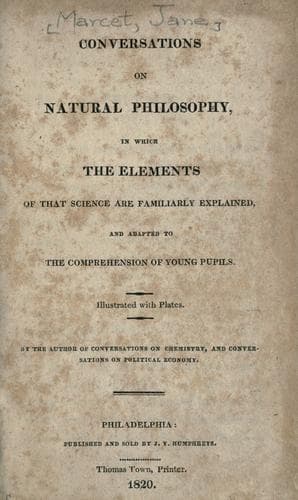
Conversations on Natural Philosophy, in which the Elements of that Science are Familiarly ExplainedMarcet, Mrs. (Jane Haldimand)
Science
Conversations on Natural Philosophy, in which the Elements of that Science are Familiarly Explained
Marcet, Mrs. (Jane Haldimand)
Physics
Its various parts, are delineated in this figure: (fig. 4. plate 14.) A
B is the pipe, or body of the pump, P the piston, V a valve, or little
door in the piston, which, opening upwards, admits the water to rise
through it, but prevents its returning, and Y, is a similar valve,
placed lower down in the body of the pump; H is the handle, which in
this model, serves to work the piston.
When the pump is in a state of inaction, the two valves are closed by
their own weight; but when, by working the handle of the pump, the
piston ascends; it raises a column of air which rested upon it, and
produces a vacuum, between the piston, and the lower valve Y; the air
beneath this valve, which is immediately over the surface of the water,
consequently expands, and forces its way through it; the water, then,
relieved from the pressure of the air, ascends into the pump. A few
strokes of the handle, totally excludes the air from the body of the
pump, and fills it with water, which, having passed through both the
valves, runs out at the spout.
_Caroline._ I understand this perfectly. When the piston is elevated,
the air, and the water, successively rise in the pump, for the same
reason as the mercury, rises in the barometer.
_Emily._ I thought that water was drawn up into a pump, by suction, in
the same manner as water may be sucked through a straw.
_Mrs. B._ It is so, into the body of the pump; for the power of suction,
is no other than that of producing a vacuum over one part of the liquid,
into which vacuum the liquid is forced, by the pressure of the
atmosphere, on another part. The action of sucking through a straw,
consists in drawing in, and confining the breath, so as to produce a
vacuum in the mouth; in consequence of which, the air within the straw,
rushes into the mouth, and is followed by the liquid, into which, the
lower end of the straw, is immersed. The principle, you see, is the
same, and the only difference consists in the mode of producing a
vacuum. In suction, the muscular powers answer the purpose of the piston
and valve.
_Emily._ Water cannot, then, be raised by a pump, above 32 feet; for the
pressure of the atmosphere will not sustain a column of water, above
that height.
Public-domain text, read in full here on John Shaqi.
Reviews
Reviews
No reviews yet
Be the first to share your thoughts on this work.
Elsewhere in the archive
Join the Discussion
Join the discussion
Sign in to leave a comment or review.
Sign InorCreate an account