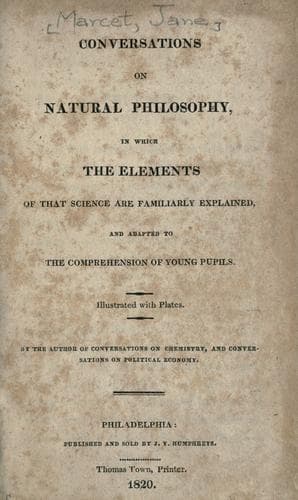
Conversations on Natural Philosophy, in which the Elements of that Science are Familiarly ExplainedMarcet, Mrs. (Jane Haldimand)
Science
Conversations on Natural Philosophy, in which the Elements of that Science are Familiarly Explained
Marcet, Mrs. (Jane Haldimand)
Physics
_Mrs. B._ Having explained the mechanical properties of air, I think it
is now time to conclude our lesson. When next we meet, I shall give you
some account of wind, and of sound, which will terminate our
observations on elastic fluids.
_Caroline._ And I shall run into the garden, to have the pleasure of
pumping, now that I understand the construction of a pump.
_Mrs. B._ And, to-morrow, I hope you will be able to tell me, whether it
is a forcing, or a common lifting pump.
Questions
1. (Pg. 136) Into what two kinds are fluids divided?
2. (Pg. 136) There are different kinds of elastic fluids, in what
properties are they alike, and in what do they differ?
3. (Pg. 136) In what particular do elastic, differ from non-elastic,
fluids?
4. (Pg. 136) What is meant by the elasticity of air?
5. (Pg. 137) What is said respecting the weight of the atmosphere?
6. (Pg. 137) Why do we not feel the pressure of the air?
7. (Pg. 137) What would be the effect of relieving us from atmospheric
pressure?
8. (Pg. 138) How may the weight of the air be shown by the aid of the
air pump, and a piece of bladder?
9. (Pg. 138) How is this explained?
10. (Pg. 138) How may its elasticity be exhibited, by an apple, and by a
bladder?
11. (Pg. 139) What is the absolute weight of a given column of
atmospheric air, and how could its whole pressure upon the earth be
ascertained?
12. (Pg. 139) How can the weight of a small bulk of air be found?
13. (Pg. 140) In ascertaining the weight of air, we take account of its
temperature--Why?
14. (Pg. 140) How could you ascertain the specific gravity of air, and
what would it be?
15. (Pg. 140) What are the essential parts of a barometer, as
represented plate 14, fig. 3?
16. (Pg. 141) What sustains the mercury in the tube?
17. (Pg. 141) Of what use are the divisions in the upper part of the
instrument?
18. (Pg. 141) To what height will the mercury rise, and what occasions
this height to vary?
19. (Pg. 141) When is the mercury highest, in wet, or in dry weather?
20. (Pg. 141) What occasions the sensation of oppression, in damp
weather?
21. (Pg. 142) Why will the barometer indicate the height of mountains,
or of balloons?
22. (Pg. 142) Is any inconvenience experienced by persons ascending to
great heights, and from what cause?
23. (Pg. 142) What occasions the rise and fall of the mercury, in a
thermometer?
24. (Pg. 142) To what height will the pressure of the atmosphere raise a
column of water?
25. (Pg. 142) What governs the difference between the height of the
mercury, and of the water?
26. (Pg. 143) How does the common pump, raise water from a well?
27. (Pg. 143) What is meant by a piston?
28. (Pg. 143) Describe the construction, and use, of a valve.
29. (Pg. 143) What are the parts of the pump, as represented, fig. 4,
plate 14.?
30. (Pg. 144) How do these parts act, in raising the water?
31. (Pg. 144) In what does that which is commonly called suction,
consist?
Public-domain text, read in full here on John Shaqi.
Reviews
Reviews
No reviews yet
Be the first to share your thoughts on this work.
Elsewhere in the archive
Join the Discussion
Join the discussion
Sign in to leave a comment or review.
Sign InorCreate an account