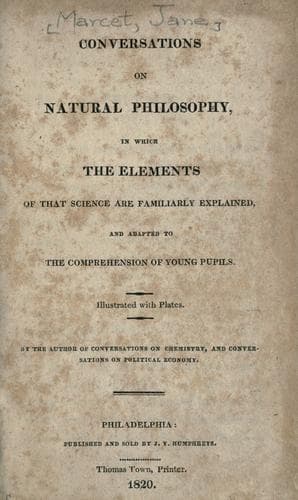
Conversations on Natural Philosophy, in which the Elements of that Science are Familiarly ExplainedMarcet, Mrs. (Jane Haldimand)
Science
Conversations on Natural Philosophy, in which the Elements of that Science are Familiarly Explained
Marcet, Mrs. (Jane Haldimand)
Physics
30. (Pg. 38) How may a light body have a greater momentum than one which
is heavier?
31. (Pg. 38) Why must we _multiply_ the weight and velocity together in
order to find the momentum?
32. (Pg. 39) When we represent weight and velocity by numbers, what must
we carefully observe?
33. (Pg. 39) Why is it particularly important, to understand the nature
of momentum?
34. (Pg. 39) What is meant by reaction, and what is the rule respecting
it?
35. (Pg. 39) How is this exemplified by the ivory balls represented in
plate 1. fig. 3?
36. (Pg. 40) Explain the manner in which the six balls represented in
fig. 4, illustrate this fact.
37. (Pg. 40) What must be the nature of bodies, in which the whole
motion is communicated from one to the other?
38. (Pg. 40) What is the result if the balls are not elastic, and how is
this explained by fig. 5?
39. (Pg. 40) How will reaction assist us in explaining the flight of a
bird?
40. (Pg. 40) How must their wings operate in enabling them to remain
stationary, to rise, and to descend?
41. (Pg. 41) Why cannot a man fly by the aid of wings?
42. (Pg. 41) How does reaction operate in enabling us to swim, or to row
a boat?
43. (Pg. 41) What constitutes elasticity?
44. (Pg. 41) Give some examples.
45. (Pg. 41) What name is given to air, and for what reason?
46. (Pg. 41) What hard bodies are mentioned as elastic?
47. (Pg. 41) Do elastic bodies exhibit any indentation after a blow? and
why not?
48. (Pg. 42) What do we conclude from elasticity respecting the contact
of the particles of a body?
49. (Pg. 42) Are those bodies always the most elastic, which are the
least dense?
50. (Pg. 42) Give examples to prove that this is not the case.
51. (Pg. 42) All bodies are believed to be porous, what is said on this
subject respecting gold?
52. (Pg. 43) What conjecture was made by sir Isaac Newton, respecting
the porosity of bodies in general?
53. (Pg. 43) If you throw an elastic body against a wall, it will
rebound; what is this occasioned by, and what is this return motion
called?
54. (Pg. 43) What do we mean by a perpendicular line?
55. (Pg. 43) What is an angle?
56. (Pg. 43) What is represented by fig. 1. plate 2?
57. (Pg. 44) Have the length of the lines which meet in a point, any
thing to do with the measurement of an angle?
58. (Pg. 44) What use can we make of compasses in measuring an angle?
59. (Pg. 44) Into what number of parts do we suppose a whole circle
divided, and what are these parts called?
60. (Pg. 44) When are two angles said to be equal?
61. (Pg. 44) Upon what does the dimension of an angle depend?
62. (Pg. 44) What number of degrees, and what portion of a circle is
there in a right angle?
63. (Pg. 44) How must one line be situated on another to form two right
angles? (fig. 1.)
64. (Pg. 44) Figure 2 represents an angle of more than 90 degrees, what
is that called?
65. (Pg. 44) What are those of less than 90 degrees called as in fig. 3?
Public-domain text, read in full here on John Shaqi.
Reviews
Reviews
No reviews yet
Be the first to share your thoughts on this work.
Join the Discussion
Join the discussion
Sign in to leave a comment or review.
Sign InorCreate an account