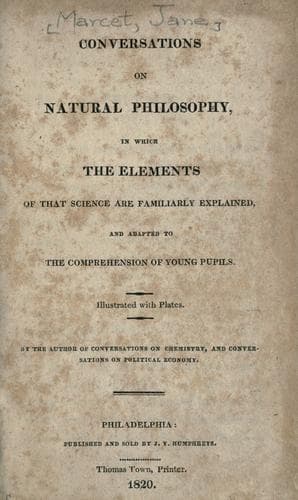
Conversations on Natural Philosophy, in which the Elements of that Science are Familiarly ExplainedMarcet, Mrs. (Jane Haldimand)
Science
Conversations on Natural Philosophy, in which the Elements of that Science are Familiarly Explained
Marcet, Mrs. (Jane Haldimand)
Physics
_Mrs. B._ Very well. This figure (fig. 4. plate 2.) represents a
billiard table; now if you draw a line A B from the point where the ball
A strikes perpendicular to the cushion, you will find that it will
divide the angle which the ball describes into two parts, or two angles;
the one will show the obliquity of the direction of the ball in its
passage towards the cushion, the other its obliquity in its passage back
from the cushion. The first is called _the angle of incidence_, the
other _the angle of reflection_; and these angles are always equal, if
the bodies are perfectly elastic.
_Caroline._ This then is the reason why, when I throw a ball obliquely
against the wall, it rebounds in an opposite oblique direction, forming
equal angles of incidence and of reflection.
_Mrs. B._ Certainly; and you will find that the more obliquely you throw
the ball, the more obliquely it will rebound.
We must now conclude; but I shall have some further observations to make
upon the laws of motion, at our next meeting.
Questions
1. (Pg. 32) On what is the science of mechanics founded?
2. (Pg. 32) In what does motion consist?
3. (Pg. 33) What is the consequence of inertia, on a body at rest?
4. (Pg. 33) What do we call that which produces motion?
5. (Pg. 33) Give some examples.
6. (Pg. 33) What may we say of gravity, of cohesion, and of heat, as
forces?
7. (Pg. 33) How will a body move, if acted on by a single force?
8. (Pg. 33) What is the reason of this?
9. (Pg. 33) What do we intend by the term velocity, and to what is it
proportional?
10. (Pg. 33) Velocity is divided into absolute and relative; what is
meant by absolute velocity?
11. (Pg. 33) How is relative velocity distinguished?
12. (Pg. 34) How do we measure the velocity of a body?
13. (Pg. 34) The time?
14. (Pg. 34) The space?
15. (Pg. 34) What is uniform motion? and give an example.
16. (Pg. 34) How is uniform motion produced?
17. (Pg. 34) A ball struck by a bat gradually loses its motion; what
causes produce this effect?
18. (Pg. 35) If gravity did not draw a projected body towards the earth,
and the resistance of the air were removed, what would be the
consequence?
19. (Pg. 35) In this case would not a great degree of force be required
to produce a continued motion?
20. (Pg. 35) What is retarded motion?
21. (Pg. 35) Give some examples.
22. (Pg. 36) What is accelerated motion?
23. (Pg. 36) Give an example.
24. (Pg. 36) Explain the mode in which gravity operates in producing
this effect.
25. (Pg. 37) What number of feet will a heavy body descend in the first
second of its fall, and at what rate will its velocity increase?
26. (Pg. 37) What is the difference in the time of the ascent and
descent, of a stone, or other body thrown upwards?
27. (Pg. 37) By what reasoning is it proved that there is no difference?
28. (Pg. 38) What is meant by the momentum of a body?
29. (Pg. 38) How do we ascertain the momentum?
Public-domain text, read in full here on John Shaqi.
Reviews
Reviews
No reviews yet
Be the first to share your thoughts on this work.
Join the Discussion
Join the discussion
Sign in to leave a comment or review.
Sign InorCreate an account