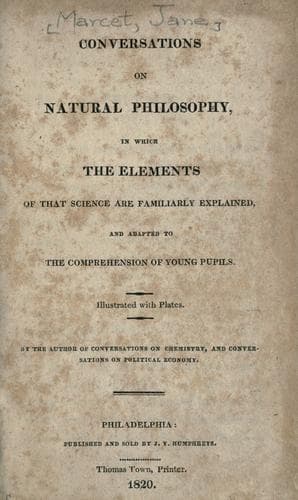
Conversations on Natural Philosophy, in which the Elements of that Science are Familiarly ExplainedMarcet, Mrs. (Jane Haldimand)
Science
Conversations on Natural Philosophy, in which the Elements of that Science are Familiarly Explained
Marcet, Mrs. (Jane Haldimand)
Physics
_Mrs. B._ That depends upon the situation of the materials; if those
which are most dense, occupy the lower part, the stability will be
increased, as the centre of gravity will be near the base. But there is
another circumstance which more materially affects the firmness of their
position, and that is their form. Bodies that have a narrow base are
easily upset, for if they are a little inclined, their centre of gravity
is no longer supported, as you may perceive in fig. 6.
_Caroline._ I have often observed with what difficulty a person carries
a single pail of water; it is owing, I suppose, to the centre of gravity
being thrown on one side; and the opposite arm is stretched out to
endeavour to bring it back to its original situation; but a pail hanging
to each arm is carried with less difficulty, because they balance each
other, and the centre of gravity remains supported by the feet.
_Mrs. B._ Very well; I have but one more remark to make on the centre of
gravity, which is, that when two bodies are fastened together by an
inflexible rod, they are to be considered as forming but one body; if
the two bodies be of equal weight, the centre of gravity will be in the
middle of the line which unites them, (fig. 7.) but if one be heavier
than the other, the centre of gravity will be proportionally nearer the
heavy body than the light one. (fig. 8.) If you were to carry a rod or
pole with an equal weight fastened at each end of it, you would hold it
in the middle of the rod, in order that the weights should balance each
other; whilst if the weights were unequal, you would hold it nearest the
greater weight, to make them balance each other.
_Emily._ And in both cases we should support the centre of gravity; and
if one weight be very considerably larger than the other, the centre of
gravity will be thrown out of the rod into the heaviest weight. (fig.
9.)
_Mrs. B._ Undoubtedly.
Questions
1. (Pg. 46) If a body be struck by two equal forces in opposite
directions, what will be the result?
2. (Pg. 46) What is fig. 5. plate 2. intended to represent?
3. (Pg. 47) How would the ball move, and how would you represent the
direction of its motion?
4. (Pg. 47) What is supposed respecting the forces represented in fig.
6?
5. (Pg. 47) How would the body move if so impelled?
6. (Pg. 47) If the forces are unequal and not at right angles, how would
the body move, as illustrated by fig. 7?
7. (Pg. 47) How must a body be acted on, to produce motion in a curve,
and what example is given?
8. (Pg. 48) When is a body said to revolve in a plane, and what is meant
by the centre of motion?
9. (Pg. 48) What is intended by the axis of motion, and what are
examples?
10. (Pg. 48) What is the middle point of a body called?
11. (Pg. 48) What is said of the axis of motion, whilst the body is
revolving?
12. (Pg. 48) When a body revolves on an axis, do all its parts move with
equal velocity?
13. (Pg. 49) How is this explained by fig. 1. plate 3?
Public-domain text, read in full here on John Shaqi.
Reviews
Reviews
No reviews yet
Be the first to share your thoughts on this work.
Join the Discussion
Join the discussion
Sign in to leave a comment or review.
Sign InorCreate an account