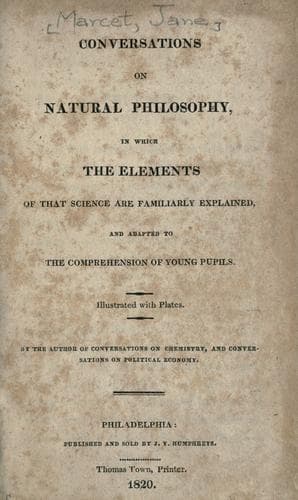
Conversations on Natural Philosophy, in which the Elements of that Science are Familiarly ExplainedMarcet, Mrs. (Jane Haldimand)
Science
Conversations on Natural Philosophy, in which the Elements of that Science are Familiarly Explained
Marcet, Mrs. (Jane Haldimand)
Physics
14. (Pg. 49) What are the two forces called which cause a body to move
in a curve; and what proportion do these two forces bear to each other
when a body revolves round a centre?
15. (Pg. 49) If the centripetal force were destroyed, how would a body
be carried by the centrifugal?
16. (Pg. 50) Explain what is meant by a _tangent_, as shown in fig. 2.
plate 3.
17. (Pg. 50) What forces impede a body thrown horizontally?
18. (Pg. 50) Give the reason why a body so projected, falls in a curve.
(fig. 3. plate 3.)
19. (Pg. 51) The curve in which it falls, is not a part of a true
circle: what is it denominated?
20. (Pg. 51) What is the _centre of gravity_ defined to be?
21. (Pg. 51) What results from supporting, or not supporting the centre
of gravity?
22. (Pg. 51) What is intended to be explained by fig. 4. plate 3?
23. (Pg. 51) What would be the effect of taking off the upper portion of
the load?
24. (Pg. 52) When will a carriage stand most firmly?
25. (Pg. 52) What is said of the centre of gravity of the human body,
and how does a rope dancer preserve his equilibrium?
26. (Pg. 52) Why cannot a sphere remain at rest on an inclined plane?
(fig. 5. plate 3.)
27. (Pg. 52) A cylinder of wood, may be made to rise to a small distance
up an inclined plane. How may this be effected? (fig. 5. plate 3.)
28. (Pg. 53) When do we find the centres of gravity, and of magnitude in
different points?
29. (Pg. 53) What influence will the density of the parts of a body
exert upon its stability?
30. (Pg. 53) What other circumstance materially affects the firmness of
position? (fig. 6. plate 3.)
31. (Pg. 53) Why is it more easy to carry a weight in each hand, than in
one only?
32. (Pg. 53) What is said respecting two bodies united by an inflexible
rod?
33. (Pg. 53) What is fig. 7, plate 3, intended to illustrate? What fig.
8; what fig. 9?
CONVERSATION V.
ON THE MECHANICAL POWERS.
OF THE POWER OF MACHINES. OF THE LEVER IN GENERAL. OF THE LEVER OF THE
FIRST KIND, HAVING THE FULCRUM BETWEEN THE POWER AND THE WEIGHT. OF THE
LEVER OF THE SECOND KIND, HAVING THE WEIGHT BETWEEN THE POWER AND THE
FULCRUM. OF THE LEVER OF THE THIRD KIND, HAVING THE POWER BETWEEN THE
FULCRUM AND THE WEIGHT.
MRS. B.
We may now proceed to examine the mechanical powers; they are six in
number: The _lever_, the _pulley_, the _wheel_ and _axle_, the _inclined
plane_, the _wedge_ and the _screw_; one or more of which enters into
the composition of every machine.
A mechanical power is an instrument by which the effect of a given force
is increased, whilst the force remains the same.
In order to understand the power of a machine, there are four things to
be considered. 1st. The power that acts: this consists in the effort of
men or horses, of weights, springs, steam, &c.
2dly. The resistance which is to be overcome by the power: this is
generally a weight to be moved. The power must always be superior to the
resistance, otherwise the machine could not be put in motion.
Public-domain text, read in full here on John Shaqi.
Reviews
Reviews
No reviews yet
Be the first to share your thoughts on this work.
Elsewhere in the archive
Join the Discussion
Join the discussion
Sign in to leave a comment or review.
Sign InorCreate an account