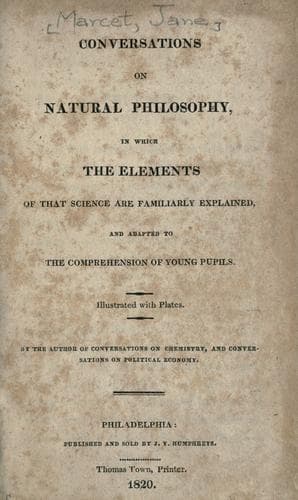
Conversations on Natural Philosophy, in which the Elements of that Science are Familiarly ExplainedMarcet, Mrs. (Jane Haldimand)
Science
Conversations on Natural Philosophy, in which the Elements of that Science are Familiarly Explained
Marcet, Mrs. (Jane Haldimand)
Physics
_Mrs. B._ It may in fact be considered as a pair of steelyards, by which
the same power enables us to ascertain the weight of different articles,
by simply increasing the distance of the power from the fulcrum; you
know that the farther a body is from the axis of motion, the greater is
its velocity.
_Caroline._ That I remember, and understand perfectly.
_Mrs. B._ You comprehend then, that the extremity of the longest arm of
a lever, must move with greater velocity than that of the shortest arm,
and that its momentum is greater in proportion.
_Emily._ No doubt, because it is farthest from the centre of motion. And
pray, Mrs. B., when my brothers play at _see-saw_, is not the plank on
which they ride, a kind of lever?
_Mrs. B._ Certainly; the log of wood which supports it from the ground
is the fulcrum, and those who ride, represent the power and the
resistance at the ends of the lever. And have you not observed that when
those who ride are of equal weight, the plank must be supported in the
middle, to make the two arms equal; whilst if the persons differ in
weight, the plank must be drawn a little farther over the prop, to make
the arms unequal, and the lightest person, who may be supposed to
represent the power, must be placed at the extremity of the longest arm.
_Caroline._ That is always the case when I ride on a plank with my
youngest brother; I have observed also that the lightest person has the
best ride, as he moves both further and quicker; and I now understand
that it is because he is more distant from the centre of motion.
_Mrs. B._ The greater velocity with which your little brother moves,
renders his momentum equal to yours.
_Caroline._ Yes; I have the most weight, he the greatest velocity; so
that upon the whole our momentums are equal. But you said, Mrs. B., that
the power should be greater than the resistance, to put the machine in
motion; how then can the plank move if the momentums of the persons who
ride are equal?
_Mrs. B._ Because each person at his descent touches and pushes against
the ground with his feet; the reaction of which gives him an impulse
which produces the motion; this spring is requisite to destroy the
equilibrium of the power and the resistance, otherwise the plank would
not move. Did you ever observe that a lever describes the arc of a
circle in its motion?
_Emily._ No; it appears to me to rise and descend perpendicularly; at
least I always thought so.
Public-domain text, read in full here on John Shaqi.
Reviews
Reviews
No reviews yet
Be the first to share your thoughts on this work.
Elsewhere in the archive
Join the Discussion
Join the discussion
Sign in to leave a comment or review.
Sign InorCreate an account