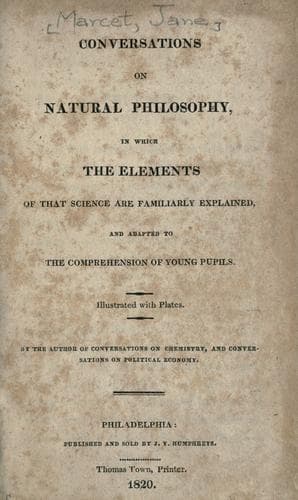
Conversations on Natural Philosophy, in which the Elements of that Science are Familiarly ExplainedMarcet, Mrs. (Jane Haldimand)
Science
Conversations on Natural Philosophy, in which the Elements of that Science are Familiarly Explained
Marcet, Mrs. (Jane Haldimand)
Physics
Your observation is true that the balance is now destroyed; but it will
answer the purpose of enabling you to comprehend the power of a lever,
when the fulcrum is not in the centre.
_Emily._ This would be an excellent contrivance for those who cheat in
the weight of their goods; by making the fulcrum a little on one side,
and placing the goods in the scale which is suspended to the longest arm
of the lever, they would appear to weigh more than they do in reality.
_Mrs. B._ You do not consider how easily the fraud would be detected;
for on the scales being emptied they would not hang in equilibrium. If
indeed the scale on the shorter arm was made heavier, so as to balance
that on the longer, they would appear to be true, whilst they were
really false.
_Emily._ True; I did not think of that circumstance. But I do not
understand why the longest arm of the lever should not be in equilibrium
with the other?
_Caroline._ It is because the momentum in the longest, is greater than
in the shortest arm; the centre of gravity, therefore, is no longer
supported.
_Mrs. B._ You are right, the fulcrum is no longer in the centre of
gravity; but if we can contrive to make the fulcrum in its present
situation become the centre of gravity, the scales will again balance
each other; for you recollect that the centre of gravity is that point
about which every part of the body is in equilibrium.
_Emily._ It has just occurred to me how this may be accomplished; put a
great weight into the scale suspended to the shortest arm of the lever,
and a smaller one into that suspended to the longest arm. Yes, I have
discovered it--look Mrs. B., the scale on the shortest arm will carry 3
lbs., and that on the longest arm only one, to restore the balance.
(fig. 3.)
_Mrs. B._ You see, therefore, that it is not so impracticable as you
imagined, to make a heavy body balance a light one; and this is in fact
the means by which you observed that an imposition in the weight of
goods might be effected, as a weight of ten or twelve ounces, might thus
be made to balance a pound of goods. If you measure both arms of the
lever, you will find that the length of the longer arm, is three times
that of the shorter; and that to produce an equilibrium, the weights
must bear the same proportion to each other, and that the greater
weight, must be on the shorter arm. Let us now take off the scales, that
we may consider the lever simply; and in this state you see that the
fulcrum is no longer the centre of gravity, because it has been removed
from the middle of the lever; but it is, and must ever be, the centre of
motion, as it is the only point which remains at rest, while the other
parts move about it.
[Illustration: PLATE IV.]
_Caroline._ The arms of the lever being different in length, it now
exactly resembles the steelyards, with which articles are so frequently
weighed.
Public-domain text, read in full here on John Shaqi.
Reviews
Reviews
No reviews yet
Be the first to share your thoughts on this work.
Elsewhere in the archive
Join the Discussion
Join the discussion
Sign in to leave a comment or review.
Sign InorCreate an account