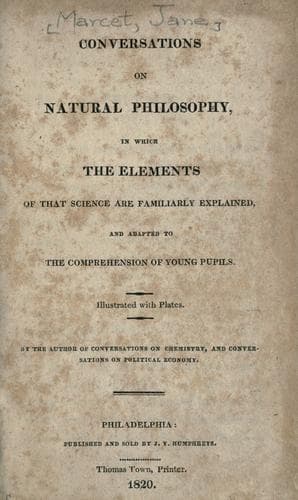
Conversations on Natural Philosophy, in which the Elements of that Science are Familiarly ExplainedMarcet, Mrs. (Jane Haldimand)
Science
Conversations on Natural Philosophy, in which the Elements of that Science are Familiarly Explained
Marcet, Mrs. (Jane Haldimand)
Physics
_Mrs. B._ If the case will admit of your putting the end of the lever
under the resisting body, no fastening will be required; as you will
perceive, when a nail is drawn by means of a hammer, which, though bent,
is a lever of the first kind; the handle being the longest arm, the
point on which it rests, the fulcrum, and the distance from that to the
part which holds the nail, the short arm. But let me hear, Caroline,
whether you can explain the action of this instrument, which is composed
of two levers united in one common fulcrum.
_Caroline._ A pair of scissors!
_Mrs. B._ You are surprised; but if you examine their construction, you
will discover that it is the power of the lever, that assists us in
cutting with scissors.
_Caroline._ Yes; I now perceive that the point at which the two levers
are screwed together, is the fulcrum; the power of the fingers is
applied to the handles, and the article to be cut, is the resistance;
therefore, the longer the handles, and the shorter the points of the
scissors, the more easily you cut with them.
_Emily._ That I have often observed, for when I cut paste-board or any
hard substance, I always make use of that part of the scissors nearest
the screw or rivet, and I now understand why it increases the power of
cutting; but I confess that I never should have discovered scissors to
have been double levers; and pray are not snuffers levers of a similar
description?
_Mrs. B._ Yes, and most kinds of pincers; the great power of which
consists in the great relative length of the handles.
Did you ever notice the swingle-tree of a carriage to which the horses
are attached when drawing?
_Emily._ O yes; this is a lever of the first kind, but the fulcrum being
in the middle, the horses should draw with equal power, whatever may be
their strength.
_Mrs. B._ That is generally the case, but it is evident that by making
one arm longer than the other, it might be adapted to horses of unequal
strength.
_Caroline._ And of what nature are the other two kinds of levers?
_Mrs. B._ In levers of the second kind, the weight, instead of being at
one end, is situated between the power and the fulcrum, (fig. 6.)
_Caroline._ The weight and the fulcrum have here changed places; and
what advantage is gained by this kind of lever?
_Mrs. B._ In moving it, the velocity of the power must necessarily be
greater than that of the weight, as it is more distant from the centre
of the motion. Have you ever seen your brother move a snow-ball by means
of a strong stick, when it became too heavy for him to move without
assistance?
_Caroline._ Oh yes; and this was a lever of the second kind, (fig. 7.)
the end of the stick, which he thrusts under the ball, and which rests
on the ground, becomes the fulcrum; the ball is the weight to be moved,
and the power his hands, applied to the other end of the lever. In this
instance there is a great difference in the length of the arms of the
lever; for the weight is almost close to the fulcrum.
Public-domain text, read in full here on John Shaqi.
Reviews
Reviews
No reviews yet
Be the first to share your thoughts on this work.
Elsewhere in the archive
Join the Discussion
Join the discussion
Sign in to leave a comment or review.
Sign InorCreate an account