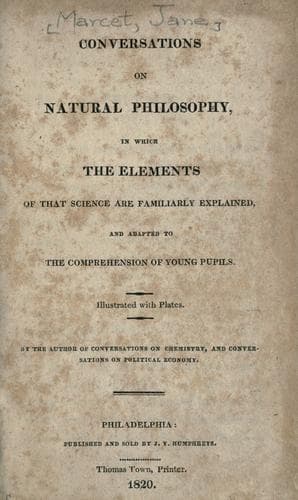
Conversations on Natural Philosophy, in which the Elements of that Science are Familiarly ExplainedMarcet, Mrs. (Jane Haldimand)
Science
Conversations on Natural Philosophy, in which the Elements of that Science are Familiarly Explained
Marcet, Mrs. (Jane Haldimand)
Physics
_Mrs. B._ And the advantage gained is proportional to this difference.
The most common example that we have of levers of the second kind, is in
the doors of our apartments.
_Emily._ The hinges represent the fulcrum, our hands the power applied
to the other end of the lever; but where is the weight to be moved?
_Mrs. B._ The door is the weight, which in this example occupies the
whole of the space between the power and the fulcrum. Nut crackers are
double levers of this kind: the hinge is the fulcrum, the nut the
resistance, and the hands the power.
In levers of the third kind (fig. 8.) the fulcrum is again at one
extremity, the weight or resistance at the other, and the power is
applied between the fulcrum and the resistance.
_Emily._ The fulcrum, the weight, or the power, then, each in its turn,
occupies some part of the lever between its extremities. But in this
third kind of lever, the weight being farther than the power from the
centre of motion, the difficulty of raising it seems increased rather
than diminished.
_Mrs. B._ That is very true; a lever of this kind is therefore never
used, unless absolutely necessary, as is the case in raising a ladder in
order to place it against a wall; the man who raises it cannot place his
hands on the upper part of the ladder, the power, therefore, is
necessarily placed much nearer to the fulcrum than to the weight.
_Caroline._ Yes, the hands are the power, the ground the fulcrum, and
the upper part of the ladder the weight.
_Mrs. B._ Nature employs this kind of lever in the structure of the
human frame. In lifting a weight with the hand, the lower part of the
arm becomes a lever of the third kind; the elbow is the fulcrum, the
muscles of the fleshy part of the arm, the power; and as these are
nearer to the elbow than to the hand, it is necessary that their power
should exceed the weight to be raised.
_Emily._ Is it not surprising that nature should have furnished us with
such disadvantageous levers?
_Mrs. B._ The disadvantage, in respect to power, is more than
counterbalanced by the convenience resulting from this structure of the
arm; and it is that no doubt which is best adapted to enable it to
perform its various functions.
There is one rule which applies to every lever, which is this: In order
to produce an equilibrium, the power must bear the same proportion to
the weight, as the length of the shorter arm does to that of the longer;
as was shown by Emily with the weights of 1 _lb._ and of 3 _lb._ Fig. 3.
plate 4.
We have dwelt so long on the lever, that we must reserve the examination
of the other mechanical powers, to our next interview.
Questions
1. (Pg. 54) How many mechanical powers are there, and what are they
named?
2. (Pg. 54) What is a mechanical power defined to be?
3. (Pg. 54) What four particulars must be observed?
4. (Pg. 54) Upon what will the velocities depend?
5. (Pg. 55) What is a lever?
6. (Pg. 55) Give a familiar example.
Public-domain text, read in full here on John Shaqi.
Reviews
Reviews
No reviews yet
Be the first to share your thoughts on this work.
Elsewhere in the archive
Join the Discussion
Join the discussion
Sign in to leave a comment or review.
Sign InorCreate an account