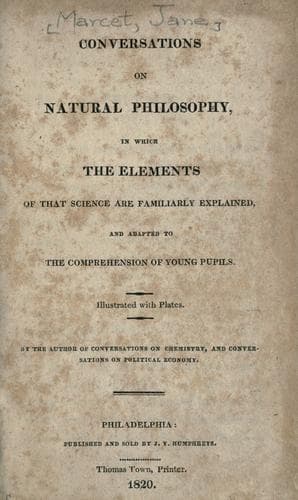
Conversations on Natural Philosophy, in which the Elements of that Science are Familiarly ExplainedMarcet, Mrs. (Jane Haldimand)
Science
Conversations on Natural Philosophy, in which the Elements of that Science are Familiarly Explained
Marcet, Mrs. (Jane Haldimand)
Physics
_Mrs. B._ Exactly so. A simple mode of illustrating the effect of these
combined forces on the earth, is to cut a slip of card in the form of a
carpenter's square, as A, B, C; (fig. 2. plate 6.) the point B will be a
right angle, the sides of the square being perpendicular to each other;
after having done this you are to describe a small circle at the angular
point B, representing the earth, and to fasten the extremity of one of
the legs of the square to a fixed point A, which we shall consider as
the sun. Thus situated, the two sides of the square will represent both
the centrifugal and centripetal forces; A B, representing the
centripetal, and B C, the centrifugal force; if you now draw it round
the fixed point, you will see how the direction of the centrifugal force
varies, constantly forming a tangent to the circle in which the earth
moves, as it is constantly at a right angle with the centripetal force.
_Emily._ The earth then, gravitates towards the sun, without the
slightest danger either of approaching nearer, or receding further from
it. How admirably this is contrived! If the two forces which produce
this curved motion, had not been so accurately adjusted, one would
ultimately have prevailed over the other, and we should either have
approached so near the sun as to have been burnt, or have receded so far
from it as to have been frozen.
_Mrs. B._ What will you say, my dear, when I tell you, that these two
forces are not, in fact, so proportioned as to produce circular motion
in the earth? We actually revolve round the sun in an elliptical or oval
orbit, the sun being situated in one of the foci or centres of the oval,
so that the sun is at some periods much nearer to the earth, than at
others.
_Caroline._ You must explain to us, at least, in what manner we avoid
the threatened destruction.
_Mrs. B._ Let us suppose that when the earth is at A, (fig. 3.) its
projectile force should not have given it a velocity sufficient to
counterbalance that of gravity, so as to enable these powers conjointly
to carry it round the sun in a circle; the earth, instead of describing
the line A C, as in the former figure, will approach nearer the sun in
the line A B.
_Caroline._ Under these circumstances, I see not what is to prevent our
approaching nearer and nearer the sun, till we fall into it: for its
attraction increases as we advance towards it, and produces an
accelerated velocity in the earth, which increases the danger.
_Mrs. B._ There is another seeming danger, of which you are not aware.
Observe, that as the earth approaches the sun, the direction of its
projectile force is no longer perpendicular to that of its attraction,
but inclines more nearly to it. When the earth reaches that part of its
orbit at B, the force of projection would carry it to D, which brings it
nearer the sun instead of bearing it away from it.
Public-domain text, read in full here on John Shaqi.
Reviews
Reviews
No reviews yet
Be the first to share your thoughts on this work.
Elsewhere in the archive
Join the Discussion
Join the discussion
Sign in to leave a comment or review.
Sign InorCreate an account