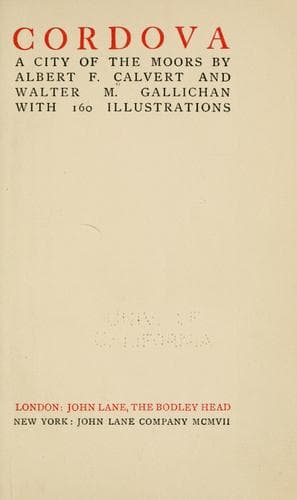
Cordova: A city of the MoorsCalvert, Albert Frederick
History
Cordova: A city of the Moors
Calvert, Albert Frederick
Arabs -- Spain; Córdoba (Spain) -- Description and travel; Córdoba (Spain) -- History
Shrinking from this terrible spectacle of the humiliation and cruelty
heaped upon the innocent head of his revered tutor, the young
Maimonides, a diligent pupil of Averroes, fled from Cordova. Averroes
soon after left the city, and wandered in Morocco. But he was not
allowed to roam unmolested. At Fez the populace treated him with gross
inhumanity. He was forced to stand on the step of the mosque, and every
one who passed into the House of Allah spat in the philosopher’s face.
Hunted, despised, and bereft of the opportunity for using his learning
for the good of humanity, Averroes dissembled and professed to repent of
his heresies. We can hardly experience surprise at this. His humiliation
and his trials had been such that few men could endure without a loss of
reason or a total paralysis of aspiration.
Averroes returned to Cordova. But he was still avoided and looked upon
as a felon, and his poverty and miserable state continued. Eventually he
was reinstated. There was a reaction of feeling; bigotry was wearing
out, and the virtues and attainments of the great thinker were
recognised at their worth. The chief work of Averroes was his
philosophy, compounded of Aristotle and the teaching of Neo-Platonism.
His writings upon Aristotle are not of the highest value, for he was
unversed in the Greek language.
Like Seneca, the Arab teacher Averroes was a rigidly plain liver. He
contented himself with common raiment, slept on hard couches, and made
only one meal in twenty-four hours. Averroes was not only reputed for
his culture and his philosophical treatises; he bore the character of
amiability, simplicity of manner, and extreme courteousness. He rises
far above Seneca in the conduct of life and the application of his
principles to actions. He was a true moral philosopher. Cordova has
produced many illustrious sons, but certainly not a greater man since
his day.
For some time the philosophy of Averroes was regarded as highly
dangerous among the Moors of Cordova. It was considered equally
injurious to the Christian faith, for all the works of the Arab doctor
were placed upon the Catholic Index.
Cordova gave many valiant soldiers to the world, but none more brave
than the Gran Capitan. The hero’s name was Fernandez Gonsalvo, or
Hernandez de Cordova. He was born in 1453, and arose to fame about 1495.
‘Nursed amid the din of battle,’ Gonsalvo accompanied his father to the
courts of Alfonso and Isabella. He fought in Portugal, showing
remarkable intrepidity at the great battle of Albuera. At Monte Frio the
Great Captain led the besiegers in scaling the ramparts. At Granada his
horse was killed beneath him, but he mounted that of his attendant, who
lost his life in the encounter. In the Calabrian campaign, Gonsalvo led
the army. For his prowess he was made Viceroy of Naples.
Public-domain text, read in full here on John Shaqi.
Reviews
Reviews
No reviews yet
Be the first to share your thoughts on this work.
Join the Discussion
Join the discussion
Sign in to leave a comment or review.
Sign InorCreate an account