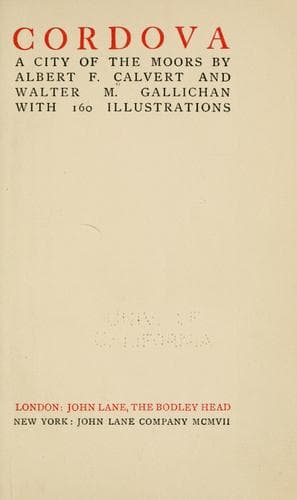
Cordova: A city of the MoorsCalvert, Albert Frederick
History
Cordova: A city of the Moors
Calvert, Albert Frederick
Arabs -- Spain; Córdoba (Spain) -- Description and travel; Córdoba (Spain) -- History
Juan de Valdés Leal was born in Cordova in 1630. Most of the painter’s
life was spent in Seville, where he was regarded as the rival of
Murillo. His most sincere, and one of his earliest compositions is in
Cordova, in the Church of the Carmen. This work is interesting because
it instances the dramatic qualities of the painter. The retablo is
painted in eleven different parts, representing the life of the prophet
Elijah. Most of the work of Valdés Leal is to be seen in Seville.
Antonio de Castillo y Saavedra, born in Cordova in 1603, revived the
best traditions of Céspedes. Castillo was one of the first of the
Spanish landscape-painters, but his strength lay in the presentment of
figures. His colour is not his _forte_, as will be seen from a study of
his pictures in the Museo. Perhaps his most admirable work is the
‘Denial of St. Peter.’ Castillo unfortunately attempted to imitate
Murillo, and it is said that he was envious of the reputation of that
more popular painter. This artist seems to have spent most of his time
in Cordova, where he died in 1667.
The poet Luis de Gongora was born in the city in 1561. His first studies
were at the University of Salamanca, whither he was sent at the age of
fifteen, to learn law. While at the College he became exceedingly worn
in health, but his disease was not mortal, and his recovery was
accounted miraculous. While still a youth Gongora wrote poetry. He
showed but little aptitude for the profession of lawyer, and upon his
return to Cordova he cultivated his bent for poetry.
In person Luis de Gongora was tall and powerfully built. He was a
caustic writer, and in his first period his style was simple and
delightful. But he became more mannered and affected as he grew older,
and his later work was marred by pomposity, extravagance, and often by
sheer absurdity. His mannerisms were, however, regarded as the fruit of
rare genius by his host of disciples and imitators. Gongorism became the
fashion among poetasters in Spain, and the followers of this master of
eccentricity were slavish flatterers and fanatical worshippers.
At forty-five Gongora left Cordova and entered the Church. He afterwards
lived in Madrid. In the capital he was under the patronage of
influential hidalgos and nobles, and Philip III. made him his honorary
chaplain. Gongora eventually returned to his native place, where he died
at the age of sixty-six, in the year 1627.
In spite of his stilted style and metrical defects, Gongora was endowed
with true poetic talent. Writing of him, Lope de Vega said: ‘I have
known this gentleman for eight-and-twenty years, and I hold him to be
possessed of the rarest and most excellent talent of any in Cordova, so
that he need not yield even to Seneca or Lucan, who were natives of the
same town.’
APPENDIX I
THE GREAT MOSQUE OF CORDOVA
Public-domain text, read in full here on John Shaqi.
Reviews
Reviews
No reviews yet
Be the first to share your thoughts on this work.
Join the Discussion
Join the discussion
Sign in to leave a comment or review.
Sign InorCreate an account